
How Much Should a Mortgage Broker Website Cost in 2026?

Sep 2, 2026 · 17 min read
The 30-second answer
A mortgage broker website costs between $619 and $12,963 in its first year if you buy a published plan, and the spread has almost nothing to do with design. On the vendor pricing pages we read on 2 September 2026, Roar Solutions charges $199 to set a mortgage site up and $35, $149 or $399 a month to keep it running. At Mortgage Website Success the ladder is $99 a month behind a $99 setup, $249 behind a $249 setup, or $997 behind a $999 setup. Above that sit custom builds from studios, which are quoted rather than listed. The number nobody prices is the one the rules create: your site is a regulated advertisement, every materially different version of it has to be kept for twenty-four months, and the software that does that keeping starts at $29 a month on its own.
What the published plans actually cost
Two vendors in this market print a full price list, and between them they cover the realistic range for a template build. Roar Solutions asks a one-time setup fee from $199 for a mortgage website and from $499 for a general small business site, then sells three monthly packages at $35, $149 and $399. The largest carries a nine month minimum term. Mortgage Website Success runs three tiers instead: Standard at $99 a month behind a $99 setup, Premiere at $249 behind a $249 setup, and Elite at $997 behind a $999 setup, with $300 a month of advertising spend folded into that top figure.
Notice what those two ladders have in common. Neither sells you a website as a project with an end date. Both sell a subscription with a small entry fee attached, which means the question is never what the site costs but what it costs to keep. That is a different question, and it has a different answer every year.
| Published plan | Setup | Monthly | Minimum term | First year |
|---|---|---|---|---|
| Roar Solutions, Small | $199 | $35 | None stated | $619 |
| Mortgage Website Success, Standard | $99 | $99 | None stated | $1,287 |
| Roar Solutions, Medium | $199 | $149 | None stated | $1,987 |
| Mortgage Website Success, Premiere | $249 | $249 | None stated | $3,237 |
| Roar Solutions, Large | $199 | $399 | Nine months | $4,987 |
| Mortgage Website Success, Elite | $999 | $997 | None stated | $12,963 |
A year in each plan
Add the setup fee to twelve months of the subscription and the market sorts itself into a clean line. The cheapest published year is $619 and the dearest is $12,963, a spread of about twenty-one to one for what is, in both cases, a template filled with your details.
The Elite figure needs one honest deduction. Of its $12,963, exactly $3,600 is advertising money that the vendor spends on your behalf rather than keeps, so the service itself is nearer $9,363. That still buys managed advertising, video production and local search work rather than a website, which is the point: at the top of this market you have stopped paying for a site and started paying for a marketing department.
One number in that chart is not really annual. Roar's Large package carries a nine month minimum term, so the smallest amount you can commit to it is the $199 setup plus nine months at $399, which is $3,790 before you are free to leave. Every other plan on both ladders bills monthly. When you compare two subscriptions, compare the exit as well as the entry, because a plan you can cancel in month three is a different product from one you cannot.
What a $199 setup fee buys
Roar Solutions is unusually specific about what its entry fee covers, and the specificity is the most useful thing on the page. Under the $199 it prints a limit: a maximum of two hours of design time, with taxes excluded and customizations liable to increase the cost.
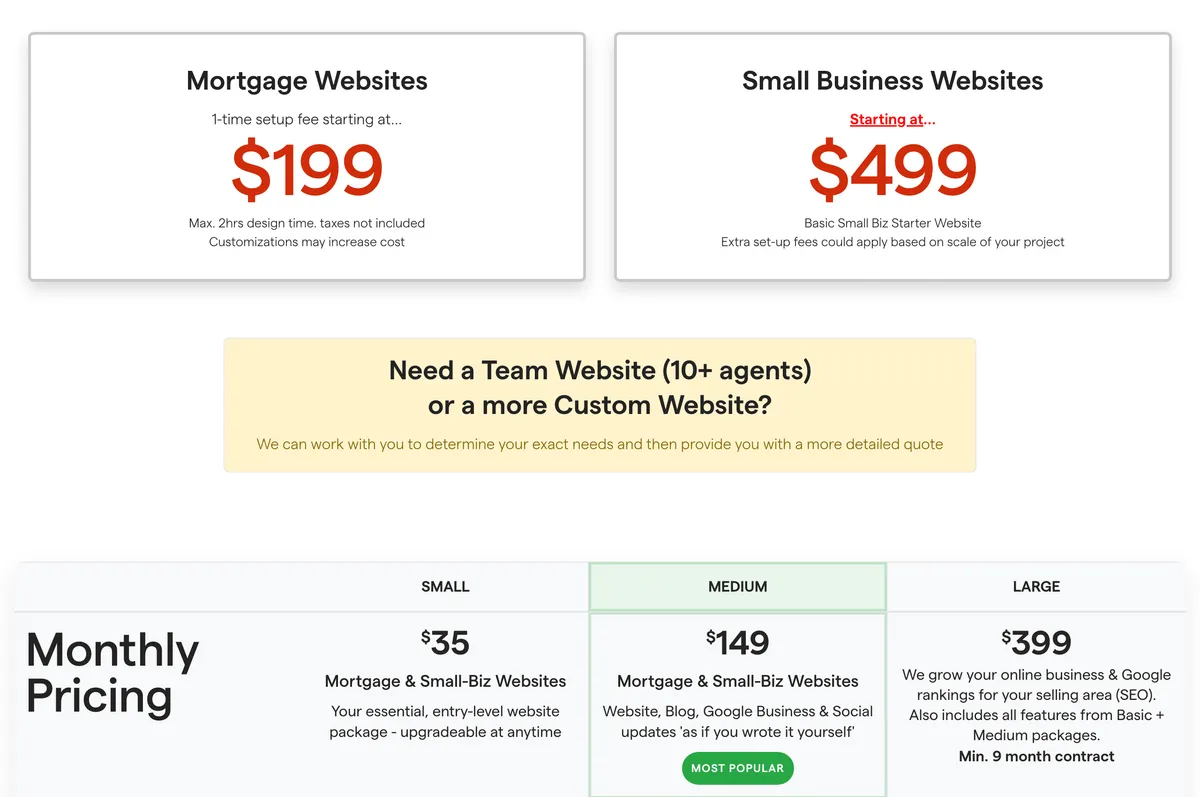
Two hours works out at $99.50 an hour, which is a defensible rate for template configuration. It is also a complete description of the product. In two hours nobody researches your market, writes your copy, photographs your team, or thinks about which of your loan programs deserves its own page. They install a theme, drop in your logo and colors, and hand it over. That is a fair trade at $199 as long as you know you are buying installation rather than design, and the vendor deserves credit for saying so on the page instead of letting you discover it later.
It is worth reading what these templates say they include, because the list is a good description of the category. The Standard tier at Mortgage Website Success promises a template branded with your logo, colors, NMLS information and headshot, mortgage calculators, an online 1003 application with document upload, a document portal and a CRM. That is a competent product. The NMLS field being a slot in a theme rather than a decision somebody made is exactly why the compliance work later falls to you.
The same honesty is missing almost everywhere else in this market. We requested the pricing pages of a dozen mortgage platforms and marketing services. Most returned a page headed Pricing with no price on it at all. Shape asks you to get a quote on every tier. Floify's pricing page carries a customer savings figure and no plan cost. leadPops names three plans and describes what each generates without saying what any of them costs.
The rule that governs your rate copy
Here is where a mortgage site stops behaving like any other small business site, in the same way that an advisor's site is an advertisement in the legal sense. 12 CFR 1026.24, the advertising section of Regulation Z, applies to your web pages by name. Paragraph (e) deals expressly with electronic advertisements, giving a website as its example, and sets out when a multiple page site counts as one advertisement rather than several.
Three of its requirements shape the copy directly. Paragraph (a) says that if you state specific credit terms, you may state only terms you actually offer. Paragraph (c) says that if you state a rate of finance charge you must state it as an annual percentage rate, using that term, and for a loan secured by a dwelling you may show no other rate except a simple annual rate, shown no more prominently than the APR. Paragraph (d) lists four triggering terms: the amount or percentage of any downpayment, the number of payments or period of repayment, the amount of any payment, and the amount of any finance charge. Print one of those and you owe the reader the downpayment, the full repayment terms including any balloon, and the APR.
Paragraph (f)(2)(ii) then decides the layout. The required disclosures must appear with equal prominence and in close proximity to the rate that triggered them. A footnote at the bottom of a long page is not close proximity to a number in a hero band, and a designer who does not know that will build you a homepage you have to take down.
Seven sentences the page may not carry
Paragraph (i) of the same section is a short list of prohibited acts for advertisements of credit secured by a dwelling, and it reads like a catalog of things marketers reach for. Using the word fixed for a rate or payment that will change, unless the advertisement carries the words Adjustable-Rate Mortgage, Variable-Rate Mortgage or ARM at least as conspicuously, before the first use of fixed. Comparing an actual or hypothetical payment against a rate that only lasts part of the term, without the comparison the rule specifies. Describing a product as a government loan program or government-supported when it is not an FHA, VA or similar program.
The list continues. Using the name of a consumer's current lender in an advertisement you send, without equal prominence for your own name and a clear statement that you are not associated with them. Any misleading claim that the product will eliminate debt or waive what someone owes another creditor. The word counselor to describe a for-profit broker or its staff. And giving trigger terms in one language while giving the required disclosures in another in the same advertisement.
None of that is a design constraint in the ordinary sense. It is a constraint on your headline, your comparison table, your paid landing pages and your Spanish version, which is why the copy on a lending site should be written before anyone opens a design tool.
Your website is a commercial communication
Regulation Z is not the only rule in the room. Part 1014, the Mortgage Acts and Practices rule, covers the same territory from a different angle, and its definitions section is unusually blunt about what counts. Its definition of a commercial communication runs through labels, radio, billboards and telemarketing scripts and then says plainly that "Web pages are included in the term commercial communication."
Section 1014.3 then makes any material misrepresentation in that communication a violation, and lists nineteen categories, (a) through (s), where one might occur. Several of them describe a claim you can find on plenty of broker homepages: the amount of interest owed each month, the existence or amount of fees including a claim that no fees are charged, prepayment penalties, whether taxes and insurance are included in a payment, and again the word fixed. The rule reaches the number in your sidebar calculator as easily as the sentence in your hero.
Twenty-four months of your own pages
The part of that rule almost no cost guide mentions is the one that creates a recurring bill. Section 1014.5 requires you to keep, for twenty-four months from the last date you disseminated it, copies of every materially different commercial communication about any term of a mortgage credit product, plus records of the products that were available while each communication was running. Failure to keep them is itself a violation of the part.
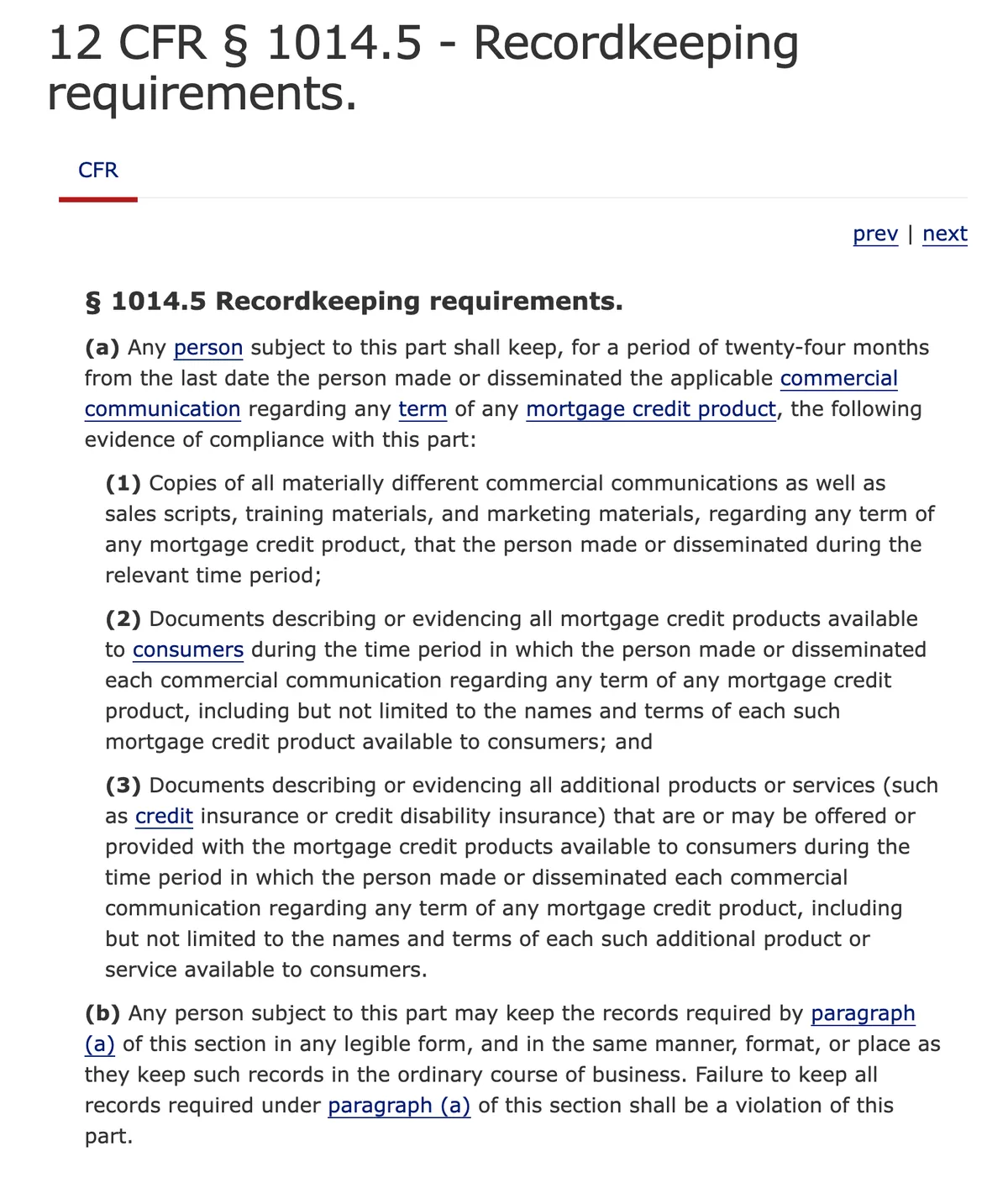
Read that against a website and the obligation becomes concrete. Every time you change a rate table, a program page, a fee line or a headline that mentions a term, you have created a materially different commercial communication, and the previous one has to survive somewhere for two years along with a record of what you were actually offering that week. A content management system does not do this on its own. Version history in a page builder is not evidence, because it disappears the day you leave the platform, which is the same reason we tell clients to keep their own copy of everything.
Scheduled capture services are built for exactly this, and one of them publishes a price. Stillio charges $29 a month to capture up to five pages, $79 for twenty-five, $199 for a hundred and $299 for unlimited pages, and holds thirty-six months of captures on every plan, which comfortably clears the twenty-four the rule asks for.
Run those rates across the retention window and the obligation prices out at $696 for five pages, $1,896 for twenty-five, $4,776 for a hundred and $7,176 for unlimited. A five page capture on the cheapest plan therefore costs $696 over the two years. That is a real number to put in a website budget, and it belongs there rather than in a compliance budget, because the thing being preserved is the website.
What we found on 24 broker homepages
We wanted to know what this actually looks like in the wild, so we ran a count. On 2 September 2026 we requested the homepage of 28 mortgage broker and loan officer sites, drawn from search results across Phoenix, Charlotte, Denver, Tampa, Columbus and the Portland area. Twenty-four distinct pages came back as readable HTML. Two refused the request, one returned an empty shell, and one turned out to be the same business on a second domain. Then we searched each page for four things.
Twenty-three of the twenty-four mention NMLS somewhere. Nineteen print an actual NMLS number. Eleven carry the words equal housing. Three publish a numeric interest rate.
Two caveats keep this honest. The count measures what the server returns rather than what a browser eventually paints, so a footer injected by a script would not be seen. That limitation is also the finding, because a search crawler and an AI answer engine read the same thing we did. And a missing string is not a violation of anything we have established here: the display rules for a state licensed originator sit in state law rather than in one federal section, and we did not check any firm's licensing status or who employs them. We are counting what is on the page, not grading anyone.
Why almost nobody publishes a rate
The three out of twenty-four figure is the most interesting number in our count, and it is a choice rather than an accident. Publishing a rate turns your homepage into the most heavily regulated page you own. It pulls in paragraph (c), it usually pulls in paragraph (d) because a payment example follows, and paragraph (f) then dictates where the APR sits and how large it is. It also has to be right today, which means someone has to update it and keep the old versions for two years.
Avoiding all that is rational. It is also expensive in a way nobody measures, because the visitor who arrived searching for a rate now has nothing to compare and leaves to find a site that has one. If you sell on price and your homepage has no number on it, you are asking the reader to book a call to learn the thing they came to find out. Some brokers make that trade deliberately. Most seem to make it by default.
What a compliant rate block looks like
One of the sites in our sample shows the alternative clearly enough to be worth reproducing. It publishes four products across a single row, each with the rate and the APR stacked one above the other in the same type size, each labeled with the loan type, each with a Rate Assumptions link underneath, and the whole block dated.
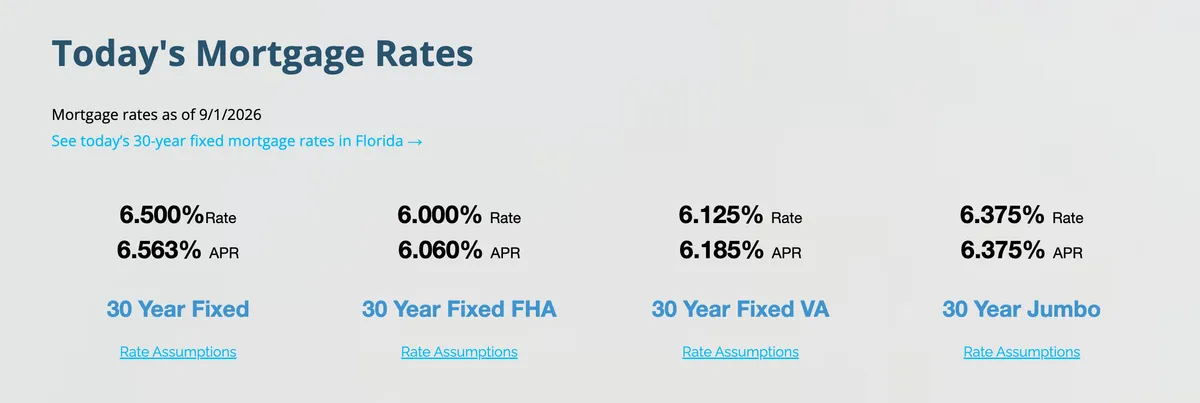
That layout is not decorative. Equal prominence is satisfied because the rate and the APR are set identically. Close proximity is satisfied because they sit two lines apart rather than a screen apart. The assumptions link carries the loan amount, credit score and term that make the figures meaningful. And the date at the top does the work that paragraph (a) needs, because it tells the reader which day these terms were actually available. Any designer can build this. Very few are asked to.
The number that belongs in the first message
For a loan originator employed by a bank or credit union, 12 CFR 1007.105 is short and specific. The institution must make its originators' unique identifiers available to consumers in a practicable way, and the originator must provide their own identifier on request, before acting as an originator, and in their initial written communication with a consumer, whether that communication is on paper or electronic.
An automated reply to a web form is an initial written communication. So is the confirmation email your site sends after a rate quote request, and so is the first text message from an automated follow up sequence. If the identifier lives only in a footer image on your homepage, none of those carry it. This is a five minute fix at build time and a tedious one afterward, because by then the templates are spread across a form tool, an email platform and a text messaging service that were bought separately.
Co-marketing with agents, and where RESPA draws the line
Co-branded pages with real estate partners come up on almost every lending build. 12 CFR 1024.14 is where that stops being a design decision. A referral, under the rule, includes any action directed at a person that has the effect of affirmatively influencing their selection of a settlement service provider, and an agreement to refer need not be written or spoken: a practice, pattern or course of conduct is enough to establish one.
The rule does permit normal promotional and educational activities, with two conditions attached. They must not be conditioned on the referral of business, and they must not defray an expense that the person in a position to refer would otherwise have incurred. A landing page you build and host for an agent, carrying their photograph and their listings, is squarely an expense they would otherwise have incurred. Build it if your compliance team has priced the arrangement properly. Do not let it arrive as a free extra in a website proposal, which is how it usually does.
The tools that get bolted on
The website is rarely the last invoice. The engagement tools that sit on top of it publish their prices more readily than the site vendors do, and they are worth pricing in the same breath. Homebot charges $125 a month for up to a hundred loaded clients, $225 for up to five hundred, and $300 for unlimited, each behind a one-time $100 setup fee, with annual billing cutting sixteen percent and saving up to $576 a year. BNTouch lists $165 a month for a solo originator and from $95 per user for a team of two to ten, plus a one-time activation fee it does not price.
BNTouch's team tier has a two user minimum, so the smallest team invoice is $190 a month rather than $95, which is more than the solo plan for the same product. Small teams of two are a genuinely awkward size in this market and it is worth checking whether two solo seats cost less than one team plan before you sign.
Divide Homebot's plans by the client counts they cap at and the shape is familiar: $1.25 per client a month on the entry plan, and $0.45 on the middle one. Per client, the cheap plan is the expensive one, and the tool only gets better value as your database fills. That is worth knowing before you buy the smallest tier out of caution.
BNTouch is also candid about the alternative. Its own comparison table prices generic CRMs at $25 to $300 a month per seat and then estimates $15,000 to $75,000 to build mortgage workflows on top of one. Whether that estimate flatters BNTouch is for you to judge, but the direction is right: a general purpose tool plus a customization project is not obviously cheaper than a specialist one.
Vendors move, and your site moves with them
One small piece of evidence for keeping your own copies. Denim Social was a compliant social publishing product aimed at lenders and their originators. Ask for its pricing page today and you land on capacity.com, on a page about social media automation, with the original domain preserved only as a query parameter. The product was absorbed.
That happens constantly in vertical software, and it is a reason to prefer a website you can export over a website that lives inside somebody's platform. When the acquirer changes the roadmap, the question is not whether you liked the old product. It is whether your pages, your forms and your two years of evidence come with you.
Weighed against a payroll
Some scale for all of this. The Bureau of Labor Statistics counted 17,331 private establishments in mortgage and nonmortgage loan brokerage in the fourth quarter of 2025, employing 86,006 people at an average weekly wage of $2,626, which annualizes to about $136,552. That is roughly five people per firm and a well paid five.
Set the website against one of those salaries. The $619 year is under half a percent of it. The $1,987 year is 1.5 percent. The $12,963 year, advertising money included, is 9.5 percent of one wage, which is a real hiring decision rather than a line item. Spread across the whole five person payroll that average implies, the top plan is about 1.9 percent of what the firm pays its people. That is defensible if it replaces a person's work. It is hard to defend as a nicer template.
The neighboring category is bigger. Real estate credit, which is where the lenders themselves sit, ran 17,710 establishments and 182,497 employees at $2,643 a week, which works out at about 10.3 people per firm against your 5.0. So the typical lender you compete with for the same search has roughly twice your headcount and a marketing function to match. The way through is specificity rather than spend. Their site cannot say what your own local market did last month. Yours can.
What we charge, and the case for buying a template
Our own figures, since it would be strange to price everyone else and hide ours. Fourteen business days from the day content and assets land is the timeline we see most often on a focused build, which is a pattern rather than a guarantee, and the bench behind it is more than 200 shipped projects. The work is a monthly subscription: $1,000 a month for Foundation Partner, $2,500 for Growth Partner and $5,000 for Scale Partner, billed monthly with no minimum, and you can pause or cancel at any point. When a finance client arrives with a rate table and a compliance reviewer, we run the disclosure conversation before the wireframe, because the required text decides how much room the headline gets.
Here is the part that loses us business. A solo originator with no rate table, no paid traffic and no plan to publish anything beyond a bio and a contact form should buy the $99 a month template, and should not call us. Buy it, put your NMLS number where a machine can read it, and spend the difference on the local relationships that actually feed a broker. Where our pricing earns its place is a site that has to carry programs, calculators, partner pages and copy a regulator might read, or a site you have measured to be losing people who arrived ready to talk.
The middle of this market is where the waste lives. Paying $399 a month for a managed template with blog posts written as if you wrote them yourself is neither the cheap option nor the good one. Either the website is a business card, in which case buy the cheapest competent one, or it is a channel, in which case it deserves original content and a build shaped around your programs.
Audit your own homepage, one sentence at a time
Here is the exercise we would run before spending anything. Open your homepage, and write down every sentence that contains a number, a superlative or a comparison. On the homepages we read, that is usually a handful rather than a page full. For each one, fill in this table. It takes about twenty minutes and it will tell you whether your next invoice is for a designer or for a copywriter.
| The sentence on your page | What it states | What has to sit next to it | Is it there? |
|---|---|---|---|
| Example: rates from 5.99% | A rate of finance charge | The same figure expressed as an APR, using that term, no less prominent | |
| Example: payments from $1,450 a month | A triggering term, the amount of a payment | Downpayment, full repayment terms including any balloon, and the APR | |
| Example: no fees, no closing costs | A claim about the existence of fees | Nothing, if it is true of the products you actually offer. Everything, if it is not | |
| Example: our fixed rate program | The word fixed | Nothing for a genuinely fixed loan. The ARM wording, first and equally prominent, if the payment can change | |
| Example: a government backed program | A government endorsement claim | An actual FHA, VA or similar program behind it | |
| Example: your loan officer, Sam | An originator acting as an originator | The originator's NMLS identifier, on the page and in the first automated email |
The fourth column is the whole point. A blank in it is not a design problem and no template will fill it, because every one of those companions is a sentence somebody has to write about products you actually sell. If the column is full, buy the cheap plan with a clear conscience. If it is empty in three rows, your website's real cost this year is the copywriting, and you have just found it before a regulator did.
One thing to do before you spend anything
Take a screenshot of your homepage today, and put it somewhere that is not your website. Then set a reminder to do it monthly. It costs nothing, it starts the twenty-four month record that section 1014.5 asks for, and the first time you look at twelve of them in a row you will see something no analytics tool will tell you: how often your most important page changes, who changed it, and whether anybody wrote the sentence that was supposed to sit next to the number.
Frequently asked questions
A published plan costs between $619 and $12,963 in its first year. Roar Solutions charges from $199 to set one up and $35, $149 or $399 a month to run it. Mortgage Website Success charges $99, $249 or $997 a month behind setup fees of $99, $249 and $999. A custom build from a studio sits above that range and is quoted rather than listed. Add the pieces up rather than guess: a $1,287 template year, $348 of scheduled captures to meet the two year retention rule, and $1,600 for one client engagement tool comes to about $3,235, which is where a careful small firm tends to land.
There is no single federal section that says a number must appear on every web page, so the answer depends on who employs you. A loan originator registered through a bank or credit union is covered by 12 CFR 1007.105, which requires the identifier on request, before acting as an originator, and in the initial written communication with a consumer, paper or electronic. State licensed originators are covered by their state's rules instead. In practice the identifier belongs on the page and inside every automated first reply, and in our count 19 of 24 broker homepages printed one.
Yes, if you show it as an annual percentage rate. 12 CFR 1026.24(c) says an advertisement stating a rate of finance charge must state it as an annual percentage rate using that term, and for a loan secured by a dwelling no other rate may appear except a simple annual rate shown no more prominently. If you also mention a payment amount, a downpayment or a repayment period, paragraph (d) requires the downpayment, the full repayment terms and the APR alongside. Paragraph (f) then requires equal prominence and close proximity, which rules out a footnote at the bottom of the page.
There are four, listed in 12 CFR 1026.24(d)(1): the amount or percentage of any downpayment, the number of payments or the period of repayment, the amount of any payment, and the amount of any finance charge. Publishing any one of them obliges you to publish the downpayment, the terms of repayment including any balloon payment, and the annual percentage rate. A monthly payment example in a calculator result or a social graphic is a triggering term in exactly the same way a headline is.
Twenty-four months. 12 CFR 1014.5 requires you to keep, for twenty-four months from the last date you disseminated it, copies of all materially different commercial communications about any term of a mortgage credit product, along with records of the products available while each was running. The rule's definitions section states plainly that web pages are commercial communications. Failing to keep the records is itself a violation, so a scheduled capture service is the cheapest way to comply; published prices start at $29 a month for five pages.
For a solo originator with no rate table and no paid traffic, yes. A $99 a month template with your license number, your programs and a contact form will do the job, and the money saved is better spent on local relationships. A template stops being enough when the site has to carry advertised rates, payment examples, partner pages or program comparisons, because every one of those pulls in disclosure text that no theme ships with and no vendor writes for you.
Not without pricing the arrangement properly first, because 12 CFR 1024.14 is written to catch exactly this. A referral includes any action that affirmatively influences someone's choice of a settlement service provider, and an agreement to refer can be established by a practice, pattern or course of conduct rather than a signed document. Normal promotional and educational activities are permitted only if they are not conditioned on referrals and do not defray an expense the referrer would otherwise have incurred. A page you build and host for an agent is such an expense, so price the arrangement with your compliance team before it appears in a website proposal.
Because publishing a rate makes the homepage the most heavily regulated page on the site. In our count of 24 broker homepages, only 3 carried a numeric rate. A published rate triggers the APR requirement, usually triggers the additional disclosures that follow a payment example, dictates the layout through the equal prominence rule, has to be accurate on the day, and adds a page that changes often to your twenty-four month retention obligation. Avoiding all of that is rational, but it also means visitors who came to compare a number leave without one.
 Development
Sep 7, 2026 · 17 min
Staffing Agency Website Cost in 2026: What 46 Agency Sites Actually Run
We measured 46 staffing agency websites and found that a staffing firm is buying two websites, not one. Here is what each half costs, who supplies it, and which one carries your legal obligations.
 Development
Aug 31, 2026 · 17 min
How Much Should a Church Website Cost in 2026?
The website is the cheap part. Tithely publishes one at $19 a month and Planning Center gives one away. The expensive part is the 2.15% to 3.00% coming off every gift the site collects, which is worth $2,465 a year on a $250,000 offering.
 Development
Aug 27, 2026 · 16 min
How Much Should a Restaurant Website Cost in 2026?
Almost nobody sells restaurants a website any more. They sell a channel with a percentage in it, and one of the biggest platforms charges your guest 5% on the plan advertised as fee free. We read eight vendors' own pricing pages and did the arithmetic.