
The Best Website Builder for a Treatment Center (and When to Skip One)

Sep 26, 2026 · 16 min read
If you run a treatment program and you are wondering whether Wix or Squarespace could carry your website, the honest answer is that one of them now can, for a narrow set of programs, and the reason has little to do with templates. It comes down to a single question most builder comparisons never ask: what happens to the words someone types into your inquiry form?
We checked the four builders people ask us about against their own terms, help centers and price lists on 26 September 2026. We also looked at what the rehab providers who actually rank in search are built on, across 58 providers in a dozen US metros. The two findings point in different directions, and both matter to your decision. We build treatment center websites for a living, so weigh that when you read the part where we say when to skip a builder. We have tried to make the part where a builder wins just as clear.
The short version
For a small treatment program that wants an inquiry form on its own site, Wix is the only one of the four big builders that will sign a business associate agreement covering its forms. That arrived in April 2026, it needs the Business plan or higher, which Wix lists at $39 a month billed yearly, and you have to switch on its PHI protection before a single inquiry arrives. Squarespace's agreement covers only its Acuity scheduling tool, and its help center says the form block cannot be part of a HIPAA solution. Webflow's terms ask you not to collect health information at all. WordPress depends on your host and plugins. Skip a builder entirely once you run paid search, track calls across several numbers, operate more than one location, or need to own the site outright.
Why the inquiry form decides it
Because an inquiry to a treatment provider is almost always protected health information, and the builder is the company holding it. A name, a phone number and a line like "looking for detox for my brother" is individually identifiable health information the moment a HIPAA covered entity receives it. Most treatment centers are covered entities, since HIPAA covers any provider that bills a health plan electronically in a standard transaction.
When that inquiry is submitted through a builder's own form, the builder stores it, emails it and shows it in a dashboard. That makes the builder a business associate, and HIPAA expects a signed business associate agreement before the first submission. Our plain guide to what HIPAA asks of a practice website covers the four places those obligations sit. The form is the one a builder choice settles.
Everything else on a treatment center site, the program pages, the staff bios, the insurance list, the photos of the house, is public information. Any builder can host it. So the practical question is narrower than "is this builder HIPAA compliant?" It is "if a family fills in the form on this site, is there a signed agreement with every company that touches their words?"
A short note on scope: this is how we read the vendors' own documents, not legal advice. If your program is weighing a platform on compliance grounds, your privacy officer or counsel should read the agreement itself before you sign up.
The four builders, one question each
Each of the four gives a different answer, and each one says so in writing. Here they are in the vendors' own words.
Wix: yes, on Business and above
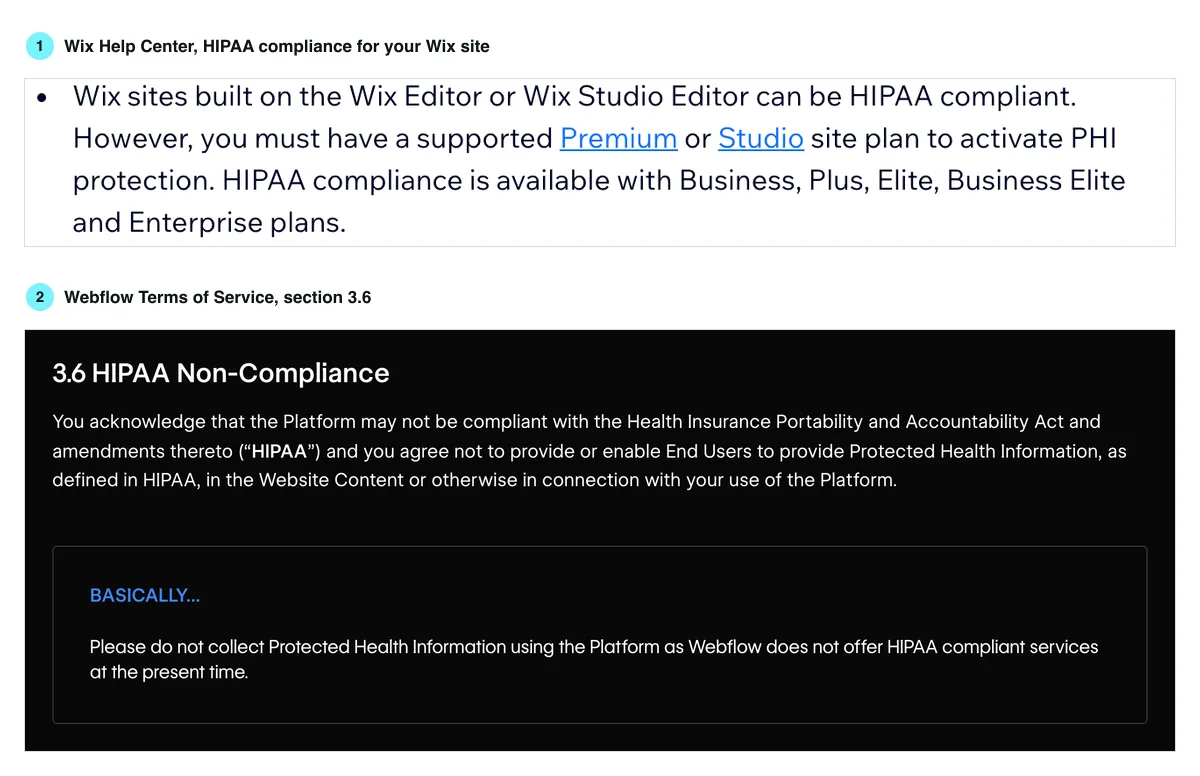
Wix announced its HIPAA offering on 7 April 2026. Its help center article on HIPAA compliance says sites built on the Wix Editor or Wix Studio can be HIPAA compliant with a supported Premium or Studio plan, and names the plans: Business, Plus, Elite, Business Elite and Enterprise. Light and Core, the two cheaper paid plans on its price list, are not on it. On the current price page Business is $39 a month and Business Elite $159, billed yearly, with a note that US dollar prices are shown for reference only and vary by location.
The setup is specific. You switch on PHI protection from the site dashboard, then sign the agreement. Once protection is on, Wix's app market shows only the apps it has marked compliant, and messaging channels that are not compliant, such as Facebook Messenger and Instagram, are disconnected. Wix also warns that switching it on may disable, restrict or remove some features, that older Wix forms should be replaced with current ones, and that any third-party app you connect is your responsibility, not theirs. If you cancel the plan, submitted data stays protected for 30 days and then falls back to ordinary Wix security. That last detail is worth writing on a sticky note if anyone else ever handles your billing.
Squarespace: only for scheduling
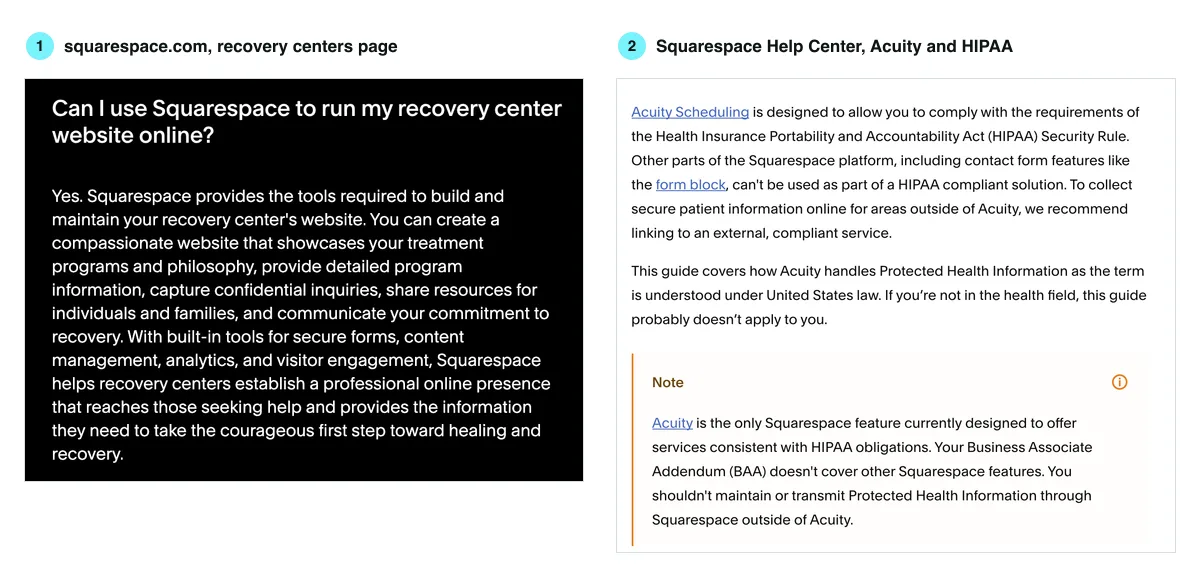
Squarespace's terms of service, effective 27 March 2025, say you may not handle protected health information on its services unless the account is designated HIPAA-enabled and you sign a separate business associate agreement. Its help center article on Acuity and HIPAA then says which account that can be. Acuity Scheduling is "the only Squarespace feature" designed for HIPAA obligations, the agreement does not cover anything else, and contact form features like the form block cannot be part of a HIPAA compliant solution. For anything outside Acuity, Squarespace recommends linking to an external, compliant service.
Acuity's own price page lists "Sign BAA for HIPAA compliance" on its Premium plan only: $49 a month billed yearly, or $61 month to month. The Starter and Standard plans at $16 and $27 do not carry it. So a Squarespace site can take appointment bookings under an agreement, but a general "tell us what is going on" form on the site itself cannot.
Here is where it gets confusing for a buyer. In our search for "best website builder for recovery centers" on the day we checked, the first result was Squarespace's own recovery centers page. Its answer to "Can I use Squarespace to run my recovery center website online?" starts with "Yes" and mentions capturing confidential inquiries and built-in tools for secure forms. Both pages are Squarespace's, and they are not answering the same question.
Webflow: no
Webflow is the clearest of the four. Section 3.6 of its terms of service, titled HIPAA Non-Compliance, has you agree not to provide or let visitors provide protected health information through the platform, and a plain-language box underneath asks you not to collect it because Webflow does not offer HIPAA compliant services. A treatment center can still use Webflow for the public site. The form just has to live somewhere else.
WordPress: it depends on who hosts it
WordPress is software, not a company you contract with, so the business associate question moves to two places: the host that stores the database and the plugin that stores or emails the submissions. Some hosts sign agreements, so ask yours before launch. Form plugins commonly store entries in the site's database and send a notification email, which puts your email provider in the chain too. The common alternative is a dedicated form service that signs an agreement. Jotform, for example, says customers who switch on its HIPAA features receive a signed agreement, and its forms embed in any of the four builders above.
The comparison on one screen
This is the table to screenshot and take into a planning meeting. Every figure in it is covered in the sections around it.
| Question | Wix | Squarespace | Webflow | WordPress |
|---|---|---|---|---|
| Will it sign a BAA covering its own forms? | Yes, since April 2026, after you switch on PHI protection | No. The BAA covers Acuity Scheduling only | No. Its terms ask you not to collect PHI at all | The software cannot sign anything. Your host and each form plugin vendor decide |
| Cheapest plan that can carry an inquiry form | Business, $39 a month billed yearly | No website plan. Acuity Premium, $49 a month billed yearly, for booking only | None | Depends on the host and plugin you pick |
| Mobile Core Web Vitals pass rate, 2025 | 74% | 69% | 65% | 45% |
| Detected accessibility errors per home page, 2026 | 33.3 | 33.0 | Not reported | 52.8 |
| Can you take the site with you? | No. It runs on Wix servers | Partial export only | Not checked for this article | Yes |
| Where it fits a treatment program | Small program that wants a form on its own site | Small program happy to take inquiries by phone | Design-led site with inquiries sent to a separate HIPAA form tool | Anything, if someone owns the upkeep |
The export row for Wix and Squarespace is covered properly in our builder versus designer comparison, including Wix's line that your site must run on its servers.
What 46 ranking rehab sites actually run on
Not builders. For this piece we ran rehab searches, drug and alcohol, across 12 US metros on 26 September 2026 (Phoenix, Denver, Nashville, Austin, Atlanta, San Diego, Houston, Chicago, Philadelphia, Seattle, Boston and Minneapolis), set aside directories, hospital systems, government pages and our own two clients, and read the homepage code of the 58 treatment providers that remained. Twelve blocked automated reading or timed out. Of the 46 we could read, 41 run on WordPress. None run on Wix, Squarespace or Webflow.
That does not mean builders fail. It means the sites that have earned first-page positions for rehab searches in big metros carry machinery a builder struggles to host. The second chart shows what that machinery is.
Three findings stand out. First, 26 of the 46 homepages load call tracking from CallTrackingMetrics, CallRail or Invoca, which swaps the phone number shown to each visitor so the center knows which ad or search produced the call. Second, 23 carry a LegitScript seal or verification link, which fits a market where Google allows ads for recovery-oriented addiction services only from providers certified by LegitScript. Third, the forms. Gravity Forms appears on 20 of them, Jotform on 4, and whether each of those forms is set up under a signed agreement cannot be seen from the outside. That part is on each operator.
A caveat we owe you: this is a sample of providers already winning search in large cities. It says nothing about the six-bed program in a small town, which is exactly who a builder is built for. Treat it as a picture of the competition you meet if you plan to fight for those searches, not as a verdict on builders.
Speed and accessibility: where builders win
On the two technical measures that are easiest to check, the hosted builders come out ahead of the typical WordPress site by a wide margin. In HTTP Archive's 2025 Web Almanac, 74% of Wix sites cleared all three Core Web Vitals on mobile, along with 69% of Squarespace sites and 65% of Webflow sites. WordPress managed 45%, measured across more than 4.8 million origins. Duda led the group at 85%.
Accessibility tells the same story. WebAIM's February 2026 scan of the top million home pages found an average of 56.1 detectable errors per page, with 95.9% of pages showing at least one WCAG failure. Squarespace home pages averaged 33.0 errors and Wix 33.3, against 52.8 on WordPress.
This matters more to treatment centers than to most businesses, because many take Medicaid, and HHS's section 504 rule requires recipients of its financial assistance to meet WCAG 2.1 AA on their websites. An interim final rule published on 11 May 2026 moved the deadline to 11 May 2027 for recipients with 15 or more employees and to 10 May 2028 for smaller ones. A builder's average is a head start, not a pass. Thirty-three detectable errors on an average page still fails, and alt text, heading order and form labels remain your job whichever platform you choose.
If you are a Part 2 program, read this twice
A business associate agreement may not be the whole agreement a substance use program needs. Programs covered by 42 CFR Part 2, the federal confidentiality rule for substance use disorder records, work with outside services under a qualified service organization agreement. Under the Part 2 definitions, that written agreement has the vendor acknowledge it is fully bound by Part 2 and commit, if necessary, to resist in judicial proceedings any effort to obtain patient records except as Part 2 permits.
The 2024 final rule, published on 16 February 2024, narrowed the gap. For a Part 2 program that is also a HIPAA covered entity, the definition now includes a business associate handling protected health information that is also a Part 2 record. If your program bills insurance electronically, a builder's HIPAA agreement probably carries more weight than it would have before the rule. If your program is cash pay and not a covered entity, it does not do that job, and you should ask the vendor directly whether it will sign Part 2 language. Expect a short answer: Wix's agreement is signed from the site dashboard, and Squarespace says it does not enter into outside agreements on the Acuity plan, offering custom ones only on Enterprise.
When a builder is the right call
For plenty of programs a builder is the correct choice, and paying an agency would be the mistake. These are the cases we would tell a friend to start on Wix or Squarespace.
- A recovery residence or sober home with only a few beds. Most inquiries arrive by phone or referral, the site answers price, rules and location, and a monthly fee over $1,000 is hard to justify. Our guide to what a sober living website should cost has the numbers for that segment.
- A single outpatient or IOP program before it advertises. Until LegitScript certification comes through, paid search is off the table anyway, so the site's job is credibility for referral partners and families who already have your name.
- A program that will take inquiries by phone only. No form means no stored health information on the website, which makes Squarespace or Webflow workable too. Put a tap-to-call number on every page and a short line saying calls are confidential.
- A program that wants a form and can live inside Wix's rules. Business plan or higher, PHI protection on before launch, the agreement signed, and only the apps Wix marks compliant. Test it by submitting an inquiry and checking where it lands.
If you recognize your program in that list, start a trial this week and spend the money on photography and good words instead. A builder will not be what holds you back for the first year.
When to skip a builder
Skip it when the website becomes the admissions engine rather than a brochure. Five signs tell you that has happened.
- You buy search ads. Paid traffic makes the landing page the whole game, and it is where the competition in our census spends its effort. A template built to suit ten thousand businesses rarely converts a family at 11pm as well as a page built for that moment.
- You track calls across several numbers. Dynamic number insertion, a CRM that records the source of each call, and forms that pass their source to the same place are routine on ranking rehab sites. Once Wix's PHI protection is on, its app market shows only the apps it has marked compliant, so check that your call tracking and CRM are on that list before you commit.
- You run more than one location. Each location needs its own pages, schema and Google Business Profile alignment, and on a builder that usually means duplicated pages kept in sync by hand.
- Your intake form needs to talk to your admissions software. A verification form that has to write insurance details into your EHR or CRM is a small integration project, and the builder's app market decides whether it is possible at all.
- You want to own the site. Wix's help center says your site must run on its servers, and its HIPAA protection lasts only as long as the plan. If a sale, a merger or a new operator is plausible in the next few years, that matters more than the monthly fee. Our piece on who owns your website lists the questions to settle first.
What a year costs, written out
A builder year for a small program is a few hundred dollars plus your own hours. The arithmetic below uses list prices from 26 September 2026, billed yearly, before tax.
- Wix Business with PHI protection: $39 a month, $468 for the year. Add any compliant apps you need.
- Squarespace Core plus Acuity Premium for bookings: $17 and $49 a month, $792 for the year, with general inquiries sent to an outside HIPAA form service at whatever that service charges.
- Webflow plus a HIPAA form service: the Webflow site plan plus the form vendor's HIPAA tier. We have not priced either here because both vary by traffic and seats. Check them on the day you decide.
What those figures leave out is the time. Someone on your team writes the pages, fixes the accessibility errors, keeps the insurance list current and reads the app market's compliance labels every time you add a tool. For a small program that trade is usually fine. For a program spending thousands a month on ads, an unfixed landing page costs more than the website does.
If you are pricing a full build rather than a builder, our breakdown of what an addiction treatment center website costs sets out the ranges.
Where KhanWork fits, and when to pass on us
KhanWork sits on the other side of this choice, as one agency among many. Every figure is public on the KhanWork pricing page. There are three plans, billed monthly at $1,000, $2,500 and $5,000, with no minimum term, and any of them can be paused or canceled at any time. The Foundation plan refreshes your brand and puts one landing page built to convert online within 14 business days of your content and assets arriving, then adds a new page each month. Growth covers the whole website with unlimited requests, one active at a time. Scale runs two requests at once for operators with several locations. The site we build is yours to keep, and hosting stays in your name. It is not something we bill for.
Over 200 projects have shipped from our studio, 5 of them for treatment centers. Cornerstone Healing Center's website conversions rose 20% once our redesign went live. That result belongs to Cornerstone, and yours would be its own number. You can see how we approach this work on our addiction treatment and recovery page and our design service page.
Do not hire us if you are a small sober living home, a program that is not yet ready to advertise, or anyone whose website budget for the year is under what our cheapest plan costs in a month. Start on a builder, follow the setup above, and come back when paid search or a second location changes the math.
Before you pick one, draw the data map
Take a sheet of paper and follow one imaginary inquiry from the moment a mother types "my son needs help" into your form. Write down every company it touches, in order: the website builder or host, the form service, the email account the notification lands in, the phone or CRM system your admissions team uses to call back, and any analytics or chat tool running on that page. Next to each name write one of three words: signed, not signed, or unsure.
Every "not signed" is a decision to make before launch, and every "unsure" is an email to send this week. If you want a second pair of eyes on the page your traffic lands on today, our free funnel review looks at exactly that. The map, though, you can draw on your own in twenty minutes, and it will tell you more about which builder fits than any comparison chart, including ours.
Frequently asked questions
For a small recovery center that wants an inquiry form on its own site, Wix is the strongest of the big builders in 2026, because it signs a business associate agreement covering its forms on the Business plan and above. Squarespace suits programs that take inquiries by phone or use Acuity Scheduling for bookings. Larger programs that run paid search usually outgrow any builder.
It can be, since April 2026, if you use a supported plan, switch on PHI protection and sign Wix's business associate agreement before collecting any inquiries. Wix lists Business, Plus, Elite, Business Elite and Enterprise as supported plans. Third-party apps you add are your responsibility, and if you cancel the plan the protection ends 30 days later.
Not under a HIPAA agreement. Squarespace's help center says contact form features like the form block cannot be part of a HIPAA compliant solution, and its business associate agreement covers only Acuity Scheduling on the Premium plan. Squarespace recommends linking to an external compliant form service for anything else.
No. Section 3.6 of Webflow's terms of service asks customers not to provide or collect protected health information on the platform, because Webflow does not offer HIPAA compliant services. A treatment center can still use Webflow for its public pages and embed a form from a service that does sign an agreement.
Almost always, once a covered provider receives it. A name, contact details and a mention of the treatment someone is seeking is individually identifiable health information. That is why the company storing and sending your form submissions needs a signed business associate agreement.
WordPress, by a wide margin. In our 26 September 2026 census of rehab providers ranking in 12 US metros, 41 of the 46 homepages we could read ran on WordPress, and none ran on Wix, Squarespace or Webflow.
Possibly, if your program is covered by 42 CFR Part 2 and a vendor handles patient records. Since the 2024 rule, a business associate of a Part 2 program that is also a HIPAA covered entity counts as a qualified service organization for those records. A cash-pay program that is not a covered entity should ask vendors directly whether they will sign Part 2 language.
When the website starts doing admissions work: running paid search, tracking calls across several numbers, serving more than one location, feeding intake into your CRM or EHR, or needing to be owned outright. Before that point a builder is usually the better use of money.
 Recovery
Sep 25, 2026 · 17 min
The Admissions Page: Anatomy of a Treatment Center Page That Gets Calls
We measured 44 admissions pages at ranking rehab providers on a phone. Most make the call easy and leave the questions a family asks before calling unanswered. Here is the page, part by part.
 Recovery
Sep 19, 2026 · 16 min
12 Addiction Treatment Website Examples Built to Convert
We loaded 37 ranking rehab homepages on a phone-sized screen and measured what a visitor can do first. These twelve each get one conversion job right, shown in annotated screenshots.
 Recovery
Sep 14, 2026 · 17 min
What LegitScript Actually Reviews on Your Website
LegitScript certifies the business, but five of its sixteen standards are read straight off your pages. We mapped each one to the page it lands on and checked 44 ranking treatment center sites against them.