
Best Web Design Agencies for Addiction Treatment Centers (2026)

Aug 1, 2026 · 14 min read
Search for the best web design agency for addiction treatment centers and you get a page of lists. Read three of them and a pattern shows up fast: nearly every list was published by an agency that placed itself at or near the top. The ranking is the advertisement.
This page is published by an agency too. We build websites for treatment centers, so we are one of the options here and we have an obvious interest in how you read it. What we can do is take the opinion out. Everything below comes from what each firm publishes about itself, on its own website or on its Clutch profile, checked in August 2026, plus a set of tests you can run on any agency in an afternoon without asking anyone's permission.
The 30-second answer
There is no single best web design agency for addiction treatment centers, and any list that crowns one is selling the crown. The market splits three ways. Behavioral health specialists such as Webserv, Lead to Recovery and Behavioral Health Partners work only in this vertical. Healthcare generalists such as Dreamscape Marketing, Stodzy Internet Marketing, Active Marketing and Onspire Health Marketing bring larger teams and a wider healthcare record. Design-led partners, which is what KhanWork is, build the site and hand it over. Pick the category that matches the gap you actually have, then test the finalists. Star ratings and years in business are the weakest signals on the table.
How this list was built
Three rules, all of them boring on purpose.
First, a firm had to have a public services page covering website design or development for addiction treatment or behavioral health providers. Second, it had to publish enough about itself to compare, meaning at minimum a location or a founding date or a public directory profile. Third, nothing on this page is our characterization of anyone's quality. We have not seen their contracts, their client rosters or their internal results, and neither have you.
Two things that follow from that are worth saying out loud. Clutch profile data is entered by the agency, not audited by Clutch, so a published minimum project size is a marketing choice rather than a fact about what your project will cost. And a firm being absent from this page means nothing at all. There are dozens of competent shops in this vertical, including several that appear on the aggregated directories but publish too little to compare fairly.
The seven firms, and what each one publishes
Listed oldest first by the date each firm publishes for itself. That order is not a ranking, it is just the only neutral order available.
Onspire Health Marketing
Onspire publishes a Kansas City, Missouri headquarters and the line "trusted healthcare marketing since 1992". Behavioral health sits inside a much broader practice that covers hospitals and health systems, academic medical centers, rural and critical access hospitals, health plans, medical device companies and a long list of clinical specialties. Services run from brand strategy and positioning through website design, content, SEO and reputation management.
Best fit when your center is part of a larger health system, or when the real problem is positioning and brand architecture rather than the website itself. Look elsewhere if you want a partner who thinks about admissions calls all day. Behavioral health is one of many verticals here.
Active Marketing
Active Marketing publishes the sentence "Active Marketing has specialized in growing admissions at addiction treatment centers since 2004", which is the longest addiction-specific tenure claim we found. The published service mix leans hard toward content, digital PR, link building and technical SEO, with PPC, CRO, email and reputation work alongside. Healthcare B2B and SaaS appear in the navigation as separate practices. No office address is published anywhere on the site.
Best fit when your gap is organic visibility and content depth over a long horizon. Look elsewhere if you need a website rebuilt as the primary deliverable, or if a published office address is part of your vendor diligence.
Dreamscape Marketing
Dreamscape publishes an address in Columbia, Maryland and a team of "70+ Digital Experts on 8 Highly Specialized Teams", extended through a partner network it describes as "350+ Industry Experts in Managed Care, Marketing, and Technology". Its Clutch profile says founded in 2005, 50 to 249 employees, $100 to $149 per hour, minimum project size $1,000, and a 5.0 rating from five reviews. Addiction treatment is one of nine published verticals that also include autism services, dental, elective medical, hospitals, mental health, non-profits, senior living and small business.
Best fit when you are a multi-location operator who needs media buying, call tracking, CRM integration and a website from one vendor with the staff to cover all of it. Look elsewhere if you want the people who built your site to still be reachable in month nine, which is harder inside a large agency.
Stodzy Internet Marketing
Stodzy publishes an address at 1700 North Dixie Highway in Boca Raton, Florida and the claim "14 Years Of Healthcare Marketing Experience". The published service list is unusually long and includes one item nobody else on this page lists: LegitScript certification support, which matters because that certification is the gate on Google advertising for addiction services. Published results claims include "1000+ Calls Per Day Across All Clients". Addiction treatment sits alongside dentistry, primary care, telehealth, ABA therapy and medispas.
Best fit when you want search and paid media handled by a team that has already walked facilities through certification. Look elsewhere if design is the thing you are unhappy about. This is a search-first shop by its own description.
Webserv
Webserv publishes an Irvine, California address and says it has supported addiction and mental health facilities since 2017 and does not serve other industries. Published numbers include "15,000+ Admissions to Facilities", "200+ Treatment centers nationwide" and "$100M+ Ad Spend Managed". Its Clutch profile lists 10 to 49 employees, $150 to $199 per hour, a $5,000 minimum project size and a 5.0 rating from 16 reviews, the largest verified review count of any firm on this page. Web design sits under a "performance creative" practice, next to admissions operations work such as lead management and eligibility.
Best fit when paid media is a large part of your admissions engine and you want the site, the ads and the intake operation under one roof. Look elsewhere if your budget cannot support managed media, since the website is positioned as one input into that machine rather than the product.
Lead to Recovery
Lead to Recovery publishes an address in Pompano Beach, Florida and describes itself as an addiction treatment website design agency first. Its Clutch profile lists founded 2019, 10 to 49 employees, $100 to $149 per hour, a $1,000 minimum and no reviews yet. The published service mix is broad for a firm this size and reaches past digital into television, radio, print and direct mail.
Best fit when you want offline and online demand handled together, which is rarer than it sounds in this vertical. Look elsewhere if third-party verified reviews are a hard requirement for your board, because there are none published yet.
Behavioral Health Partners
Behavioral Health Partners publishes a Denver, Colorado address and a service list that goes past marketing into treatment consulting: licensing, accreditation support and feasibility studies for people opening centers and sober living homes. Its Clutch profile lists founded 2024, 10 to 49 employees, $200 to $300 per hour, a $10,000 minimum and a 5.0 rating from one review. Both the rate and the minimum are the highest published on this page.
Best fit when you are opening or expanding and want the licensing conversation and the marketing conversation in the same room. Look elsewhere if you need a long verifiable track record, since the firm publishes a 2024 founding date.
Side by side
Everything in this table is published by the firm on its own site or its Clutch profile, checked August 2026. Blank means the firm publishes nothing on that point, which is itself worth knowing.
| Firm | Published HQ | In the niche since | Published team size | Published price signal | Verified reviews |
|---|---|---|---|---|---|
| Onspire Health Marketing | Kansas City, MO | 1992, healthcare broadly | Not published | None | Not on Clutch |
| Active Marketing | Not published | 2004, addiction treatment | Not published | None | Not on Clutch |
| Dreamscape Marketing | Columbia, MD | 2005, healthcare broadly | 70+ staff, 50 to 249 on Clutch | $100 to $149 per hour, $1,000 minimum | 5 reviews, 5.0 |
| Stodzy Internet Marketing | Boca Raton, FL | 14 years, healthcare broadly | Not published | None | Not on Clutch |
| Webserv | Irvine, CA | 2017, behavioral health only | 10 to 49 on Clutch | $150 to $199 per hour, $5,000 minimum | 16 reviews, 5.0 |
| Lead to Recovery | Pompano Beach, FL | 2019, addiction and mental health | 10 to 49 on Clutch | $100 to $149 per hour, $1,000 minimum | 0 reviews |
| Behavioral Health Partners | Denver, CO | 2024, behavioral health | 10 to 49 on Clutch | $200 to $300 per hour, $10,000 minimum | 1 review, 5.0 |
| KhanWork | Remote, US and Europe clients | Design partner, 200+ projects shipped | Small senior team | $1,499 flat one time, $2,499 per month | See our wall of love |
What tenure tells you, and what it does not
Tenure tells you a firm has survived, which in a vertical this volatile is not nothing. It does not tell you the site they will build you is fast, that the person who sold you will touch the work, or that the template they used in 2019 has been rethought since.
Read that chart against the pricing one below and the ranking logic falls apart. The firm with the longest published history is a broad healthcare agency where behavioral health is one practice among many. The firm founded most recently publishes the highest hourly rate on the page. Neither of those facts predicts whether your admissions line rings.
A better question than "how long have you been doing this" is "show me a treatment center site you launched in the last twelve months". Recent work is testable. Tenure is not.
What they publish about money
Three of the seven publish no price signal anywhere. That is normal in this vertical, and it is the single biggest reason buyers end up comparing quotes that are ten times apart.
Treat published minimums with care. Dreamscape lists a $1,000 minimum project size next to a 50 to 249 person headcount, which tells you the field is a directory setting rather than a quote. The useful signal in that data is the hourly band, because it maps to seniority and overhead more honestly than a minimum does.
We publish ours because we think hiding it wastes everybody's time: $1,499 flat for a one time build and $2,499 per month for an ongoing partnership. The $1,499 is a package price for a focused scope, not a from-price that grows during the call. For the wider market ranges, including the compliance line items nobody quotes, we broke the numbers down in what a treatment center website actually costs in 2026.
Specialist or generalist
The specialist argument is real. A firm that only works with treatment centers already knows what an admissions funnel looks like at 2am, how families read a staff page, and which claims will get an ad account suspended. You will not spend the first month explaining your business.
The generalist argument is also real, and it gets dismissed too easily. Vertical specialists tend to converge on a house template, which is why so many treatment center websites look like each other: same hero, same stock photo of a hand on a shoulder, same six trust badges. If everyone in your market hired from the same short list of specialists, the fastest way to look different is to hire outside it.
The honest split we use: hire a specialist when the bottleneck is media buying, compliance or admissions operations. Hire a design-led partner when the bottleneck is that your site does not convince anyone. If you are not sure which it is, our addiction recovery page lays out the four things families check before they call.
Nine questions that separate them
Ask all nine on the first call. The answers take an hour and save a year.
- Show me a center site you launched in the last twelve months. Not a portfolio grid, a live URL you shipped recently.
- Who owns the domain, the code, the analytics property and the ad account? The correct answer is your legal entity, on every one of them.
- What happens to the site if we stop paying monthly? If the answer is that it goes away, you are renting, and that should be priced as rent.
- Do you also sell leads, run a directory, or represent other centers in my market? Any of those can be fine, but you want it on the record before you sign, not after.
- Who writes the clinical copy, and who reviews it? Someone at your facility has to own accuracy about levels of care.
- What tracking goes on our condition pages, and who signed off on it? See the test section below.
- Can my admissions team edit a page without a ticket? If not, every typo becomes a two-day request.
- What will you report on, leads or admissions? Lead counts are easy to inflate. Admissions are not.
- Can I speak to a client who left you? The reaction to this question is more informative than the referral.
The test you can run before you sign
You do not need a technical background for any of this, and it takes about twenty minutes per finalist.
Run their own site, then three client sites, through PageSpeed Insights. Google publishes the thresholds it uses: a Largest Contentful Paint of 2.5 seconds or less, an Interaction to Next Paint of 200 milliseconds or less and a Cumulative Layout Shift of 0.1 or less, all measured at the 75th percentile of real page loads. Passing is not a high bar and most of the web still fails it. The HTTP Archive's 2024 Web Almanac found 43% of mobile websites had good Core Web Vitals. If an agency sells speed and its own site fails, you have learned something free.
Ask what goes on the condition pages. Marketing pixels on pages about detox, dual diagnosis or specific substances have been the noisiest compliance topic in this field, and the picture changed in 2024. On June 20, 2024, a federal judge in the Northern District of Texas vacated the part of the HHS Office for Civil Rights online tracking bulletin that treated an IP address on an unauthenticated public health page as protected health information, holding the agency had acted beyond its authority under HIPAA, and HHS later withdrew its appeal. That does not make tracking a free-for-all, and 42 CFR Part 2 still governs substance use disorder patient records separately. It does mean the decision belongs to you and your counsel rather than to a vendor's default settings. Any agency that cannot tell you exactly what it installs, and why, is answering the wrong question.
Check the domain registration. A public WHOIS lookup on your own domain takes thirty seconds. If your previous agency is the registrant, fix that before you start talking to anyone new.
Four things that should end the conversation
A guaranteed number of admissions. Nobody can promise that, and the promise usually comes attached to a compensation structure worth reading closely, which we covered in how centers fill beds without buying leads.
A refusal to name the platform your site will be built on. You are entitled to know what you will be maintaining.
A proposal with no page-level scope. "A 12-page website" is not a scope. Which twelve, saying what, ranked for what.
A portfolio you cannot click. Screenshots are not evidence. Live URLs are.
Where we fit, and who should not hire us
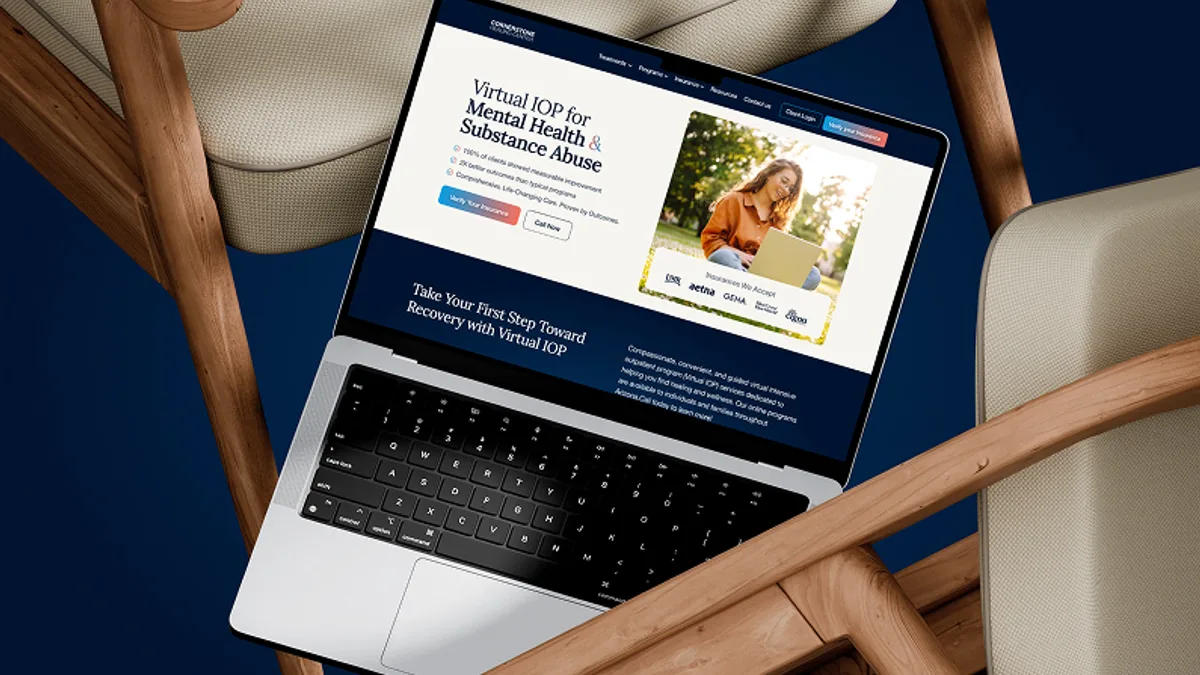
KhanWork is a design and development partner. We have shipped 200+ projects across the US and Europe, we answer partnership requests within 48 hours, and a focused build typically launches in about two weeks. Cornerstone Healing Center saw 20% more website conversions once their redesign went live. We publish our prices, we build the site to be fast, and the domain, the code and the analytics are yours from day one.
Here is who should not hire us. If your main need is a team to place and manage a large paid media budget every month, hire one of the specialists above, because that is their craft and not ours. If you want a vendor to sit in your weekly census meeting and own admissions operations, same answer. If you want the cheapest possible template, there are shops that will beat us and you will get what you paid for. We are the right call when the website itself is the problem: it is slow, it does not look like anywhere a family would trust their son, and it does not turn the traffic you already have into calls.
How to run this in two weeks
Week one: pick three firms across two categories, one specialist and one design-led at minimum. Run the speed test and the domain check before the calls so you arrive with evidence. Ask the nine questions and write down who dodged which.
Week two: ask each finalist for a small paid first scope rather than a twelve month contract. A homepage, a single level-of-care page, or a paid discovery. You will learn more about how a firm works from three weeks of real work than from any pitch deck, and the cost of being wrong stays small.
Then pick, and give whoever you pick a fair run. The most expensive pattern in this vertical is not choosing the wrong agency. It is changing agency every nine months and starting the compounding over each time.
Frequently asked questions
There is no single best one, and any list that names one was almost certainly published by that agency. The right choice depends on your bottleneck. If it is paid media and admissions operations, a behavioral health specialist such as Webserv or Behavioral Health Partners fits. If it is scale across several locations and services, a larger healthcare agency such as Dreamscape Marketing fits. If the website itself is what is failing, a design-led partner fits. Shortlist three firms across two of those categories, then test them with live URLs, a speed check and the ownership questions rather than by reading rankings.
 Recovery
Jul 31, 2026 · 15 min
Rehab Marketing Without Buying Leads: How Treatment Centers Fill Beds in 2026
Aggregator calls get more expensive every year, and the FTC has started naming the treatment centers that buy them. Here is the owned-channel alternative: the law, the certification costs, and the order to build in.
 Recovery
Jul 30, 2026 · 15 min
Addiction Treatment Center Website Cost in 2026: Real Numbers
Quotes run from $500 to six figures for a rehab website. Here is the real 2026 range, the compliance line items nobody quotes, and the admissions math.
 Recovery
Jun 18, 2026 · 8 min
How to Design an Addiction Recovery Website That Actually Converts
Recovery websites carry more weight than most. Here's how to design for trust, compliance and conversion so the people who need help actually reach out.