
Addiction Treatment Center Website Cost in 2026: Real Numbers

Jul 30, 2026 · 15 min read
If you are budgeting a website for a treatment center, you have probably collected quotes that make no sense next to each other. A freelancer says $3,000. A healthcare agency says $40,000. A "top rehab web design" list is full of firms that refuse to publish a single number. Same project, quotes 10 to 30 times apart, and nobody explains the gap.
The confusion is not your fault. Almost no agency in the addiction treatment space publishes pricing. The few public numbers range from $3,500–$6,000 entry-level builds to $50,000–$120,000 multi-location custom projects. Both can be legitimate. They are simply different products wearing the same name.
This guide gives you the real numbers: published agency tiers, itemized line costs, the compliance fees unique to addiction treatment (LegitScript alone is $4,690 in year one), and the admissions math that tells you what a website is actually worth. Every market figure links to its source. Where we state our own pricing, we say so plainly.
The 30-second answer
In 2026, most US addiction treatment centers pay $5,000–$15,000 for a professional single-location website, $15,000–$50,000 for a custom conversion-focused build with CRM, call tracking, and insurance verification, and $50,000–$120,000+ for multi-location operators. Template builds start around $2,000–$5,000. Add rehab-specific overhead: LegitScript certification ($1,595 application plus $3,095 per year, per facility), HIPAA-aware forms ($2,000–$8,000 setup), and $150–$800 per month in upkeep. One admission is worth $15,000–$50,000, so a site that produces even one extra admission has paid for itself.
Key takeaways
- The realistic 2026 range is $5,000–$15,000 for a solid single-location site and $15,000–$50,000 for a custom build with admissions integrations. Quotes differ by 10–30x because the products differ, not because one party is lying.
- LegitScript certification is a website cost in disguise: $1,595 to apply plus $3,095 per year, charged per facility at the 1–9 facility rate, and Google and Meta will not run your addiction treatment ads without it.
- HIPAA is a real line item, not padding: $2,000–$8,000 of implementation up front and $200–$800 per month of monitoring, plus $99–$129 per month for a form tool that will sign a BAA (Business Associate Agreement).
- The ROI math is brutal and in your favor: paid media averaged $16,608 per admission in 2025, and one admission is worth $15,000–$50,000. A website that converts better is the cheapest admission source you can buy.
- Cheap sites are 2-year assets, well-built sites last 5+ years. Amortized, the expensive site is usually cheaper.
- The number one contract risk is ownership: if the agency keeps your domain or code, you are renting, not buying.
Treatment center website costs at a glance
You have four ways to get a website built, and each occupies a different price band with a different risk profile. The table below is the honest version of the market in 2026, built from published prices and buyer surveys rather than sales pages.
| Option | Typical price | Timeline | What you get | Main risk |
|---|---|---|---|---|
| DIY builder (Wix, Squarespace, WordPress) | $200–$1,900/yr in subscriptions | Days to weeks of your time | A template site you maintain yourself | Not HIPAA-ready out of the box; weak conversion; your time is not free |
| Freelancer | $2,500–$10,000 | 4–8 weeks | Custom design on a standard platform | No compliance depth; single point of failure; 57% of freelance projects land in this band per a 2025 survey of 208 designers |
| General web agency | $6,500–$25,000 | 8–16 weeks | Full design, development, and content process; WebFX prices basic complete projects at $6,500–$15,000 | Learns healthcare compliance on your dime; no LegitScript awareness |
| Specialist healthcare / recovery agency | $8,000–$25,000 published tiers; one premium specialist reports typical builds of $25,000–$80,000 | 8–20 weeks | Compliance-ready build, insurance verification (VOB) workflows, CRM and call tracking, admissions-focused UX | Premium pricing; some firms use the niche to justify padding, so demand itemization |
One reference point for the top band: specialist agency Webserv publishes tiers at $8,000 (10 pages, one location), $15,000 (20 pages, three locations), and $25,000 (40+ pages, five or more locations). At the other end, DrugRehab.Agency publishes $3,500–$6,000 builds delivered in 30 days. Both are real. The difference is everything in the next section.
What actually determines the price
Six factors explain nearly every dollar of difference between a $5,000 quote and a $50,000 quote. If a proposal cannot tell you where it sits on each of these, it is a guess, not a quote.
1. Who builds it
Labor is the biggest input. Freelance designers charge a median of $92.75 per hour, agency surveys by GoodFirms show about half of development agencies quoting $3,000–$15,000 for small projects, and enterprise firms bill $225–$350+ per hour. The same 100-hour project costs $9,000 with one seller and $30,000 with another before scope changes at all.
2. Locations and levels of care
Every location adds pages, local SEO work, and structured data. Every level of care (detox, residential, PHP, IOP, outpatient) adds a content cluster that has to be clinically accurate. Published specialist tiers nearly double from one location to three ($8,000 to $15,000) and climb again past five locations ($25,000).
3. Integration depth
CRM integration, admissions call tracking, and an insurance verification (VOB) form workflow each add roughly $3,000–$10,000 per integration. A center running paid media usually needs all three, which alone can add $10,000–$30,000 to a build.
4. Compliance scope
HIPAA-aware implementation runs $2,000–$4,000 for basic measures and $5,000–$8,000 for comprehensive setups. Anything that collects protected health information (PHI, meaning identifiable health data) needs encrypted handling and a vendor who will sign a Business Associate Agreement. Stock WordPress and stock form plugins do not qualify.
5. Content and photography
Professional copywriting runs $60–$300 per page, and commercial photography runs $800–$3,000 per day. In this niche, real photos of your facility and staff are close to mandatory, because families deciding where to send a loved one can smell stock photography instantly.
6. Conversion engineering
A brochure shows information. An admissions engine moves a frightened family from a 2 a.m. search to a phone call in as few steps as possible. That work (crisis-sensitive UX, insurance-first messaging, sticky call bars, tested page layouts) is the real product a specialist sells, and we break it down in our guide to recovery website design that converts.
Where the money goes in a professional build
On a typical custom healthcare build, roughly 60% of the budget goes to design and development, with the rest split across strategy, content, compliance, and testing. Here are the published phase ranges from Patient10x's healthcare cost breakdown, which span everything from a small practice to a hospital system:
- Strategy and planning: $2,500–$15,000. Sitemap, admissions journey mapping, competitor and keyword research.
- Design: $5,000–$35,000. Brand application, page layouts, mobile-first UX, trust and credential presentation.
- Development: $8,000–$60,000. The actual build, CMS setup, speed optimization, tracking.
- Content: $3,000–$20,000. Clinically reviewed copy for every level of care, plus photography.
- Compliance setup: $2,000–$8,000. HIPAA-aware forms, encryption, accessibility (WCAG), audit trails.
- Integrations: $3,000–$25,000. CRM, call tracking, VOB workflow, analytics that do not leak PHI.
Quality assurance rarely appears as its own line, but it is why timelines run 8–16 weeks instead of 8 days: cross-device testing, accessibility checks, redirect mapping so you do not lose existing rankings, and a compliance review before anything goes live. When a quote is dramatically cheaper, one or more of these lines has quietly been deleted. Your job is to find out which one.
Treatment-center costs nobody quotes you for
Addiction treatment carries five cost lines that generic website guides never mention, and they are the reason a rehab site costs more than a dentist's site. Budget for these separately from the build itself.
LegitScript certification
If you want to run Google or Meta ads for addiction treatment, LegitScript certification is mandatory, and its fees are published: $1,595 to apply plus $3,095 per year per facility at the 1–9 facility rate, or $535 plus $1,070 per year for an individual practitioner. Expedited two-day review costs an extra $2,500. That is $4,690 in year one before you spend a dollar on ads.
Here is why it belongs in your website budget: LegitScript reviews your website itself, including clinical claims, staff credentials, ownership transparency, and required disclosures. A site written without those requirements in mind gets rejected and rewritten at your expense.
HIPAA-compliant forms
Any form that asks about someone's substance use collects PHI, and the free tier of every form builder is off the table. A form vendor that signs a BAA costs real money: Jotform gates HIPAA features to its $129 per month Gold plan, and Formstack's BAA-covered tier starts at $99 per month. That is $1,200–$1,550 per year, forever.
Insurance verification (VOB) workflow
A "verify my insurance" page is the highest-intent conversion point on a rehab site, and building it properly (secure intake, routing to your admissions team or VOB software) runs $3,000–$10,000 on the build side, with verification software adding $300–$800 per month depending on CRM integration.
Accreditation trust signals
Joint Commission and CARF badges convert because families and referents look for them, but they are not free to earn: Joint Commission behavioral health applications run $1,700–$8,000 with annual fees on top, per published estimates, while CARF's own fee schedule lists a $995 application. Displaying them correctly, above the fold and verifiable, is part of the design job. Our guide to healthcare trust principles covers how.
Real photography
A half-day shoot of your facility and team runs $800–$2,000, a full day $1,500–$3,000 or more. It is the highest-leverage $2,000 in this entire article, because trust is the product a treatment center website sells.
Ongoing costs after launch
Plan on $150–$800 per month after launch for a professionally maintained treatment center site, before any marketing retainers. The build is a one-time cost. These are not: Budget reviews are worth calendaring: set a reminder every quarter to check that hosting, plugins, and form tools are still on current versions, because most emergency rebuild invoices we see started as a $30 per month maintenance gap that nobody owned.
- Hosting: $20–$100 per month. Managed WordPress hosting starts at $20–$35 per month (WP Engine, Kinsta); modern Next.js hosting sits in a similar band with better speed.
- Maintenance and updates: $95–$400 per month is the typical small business band, covering software updates, backups, security patches, and small content changes.
- Compliance monitoring: $200–$800 per month for practices handling PHI, per Patient10x.
- HIPAA form tooling: $99–$129 per month, as covered above.
- Optional growth retainers: $500–$2,500 per month for ongoing SEO and content, which increasingly includes showing up in AI answers. We cover that shift in getting recommended by ChatGPT and Google AI.
Run the five-year total: a $12,000 build plus $300 per month is $30,000 over five years. That number should not scare you. It should change which question you ask, from "what does the site cost" to "what does the site produce." Which brings us to the math.
The ROI math: one admission pays for the website
A treatment center website pays for itself with a single admission, and that is not a slogan, it is arithmetic. Here are the two numbers that matter.
First, what an admission costs to buy with ads. Webserv's 2025 State of Rehab Marketing, an agency benchmark across $16.5 million in managed ad spend, 40,652 leads, and 994 admissions, found an average cost of $406 per lead and $16,608 per admission, with only 2.4% of leads becoming admits.
Second, what an admission is worth. Published figures put the value at roughly $15,000 for outpatient and up to $50,000 for residential, consistent with consumer-side pricing of about $12,500 on average for a 30-day inpatient stay.
Now connect them. Your website is the conversion endpoint for every dollar of that spend: the ad click costs the same whether your site converts 2% or 4% of visitors, but the second site cuts your cost per admission nearly in half. A $15,000 site that produces just one extra admission per quarter returns its full cost in the first quarter, then keeps producing.
Two more anchors to kill the sticker shock. Rehab digital marketing budgets commonly run $3,000–$25,000 per month, so a full custom website equals a few weeks of the ad spend you already accept, paid once. And websites are multi-year assets: Orbit Media measured leading marketing sites lasting about 2 years, while well-built sites averaged over 6. The cheap site is a 2-year rental. The good one amortizes across 5+ years of admissions.
Cheap website risks and agency red flags
The biggest budgeting risk is not overpaying, it is buying a cheap site that quietly burns your ad spend for two years. The failure modes are concrete: template layouts that cannot hold VOB forms and admissions flows, PHI collected through non-BAA form plugins, accessibility gaps that invite ADA demand letters, and redesigns that wipe out rankings through botched redirects.
The agency-side red flags are just as consistent across every buyer forum and every burned marketing director we have talked to:
- Guaranteed rankings or guaranteed admissions. Nobody can promise either. Walk away.
- 100% payment up front. Standard structure is a deposit with milestone payments.
- The agency keeps ownership of your domain, site, or code. This is the hostage clause, and it is the most expensive mistake on this list.
- No discovery questions. If they quote before asking about your levels of care, locations, and admissions process, they are selling a template.
- No itemized quote. A single mystery number means you cannot compare, negotiate, or audit.
- Screenshot-only portfolio. Ask for live URLs and a verifiable result.
How KhanWork prices it
We publish our pricing, which is rare enough in this niche to be a differentiator by itself. KhanWork is a US-focused design, development, and growth agency specializing in addiction treatment and recovery centers, with 200+ projects shipped, and every site built on Next.js for speed. Here is where each tier fits:
- Foundation Partner, $1,499 one time. Full branding plus a high-converting landing page, launched in two weeks with unlimited revisions. Fits new or pre-launch centers that need a credible, compliant presence before the full site.
- Design Partner, $2,499 per month. Full website design and build with 48-hour turnaround on requests, plus growth, social, and collateral design. Three months of Design Partner is $7,497, which sits below most single-location agency quotes while including ongoing iteration instead of a handoff.
- Growth Partner, $4,999 per month. Everything in Design plus conversion optimization, SEO and content, A/B testing, 24-hour turnaround, and a dedicated project manager. Fits centers already spending on ads, where the website's conversion rate directly sets cost per admission.
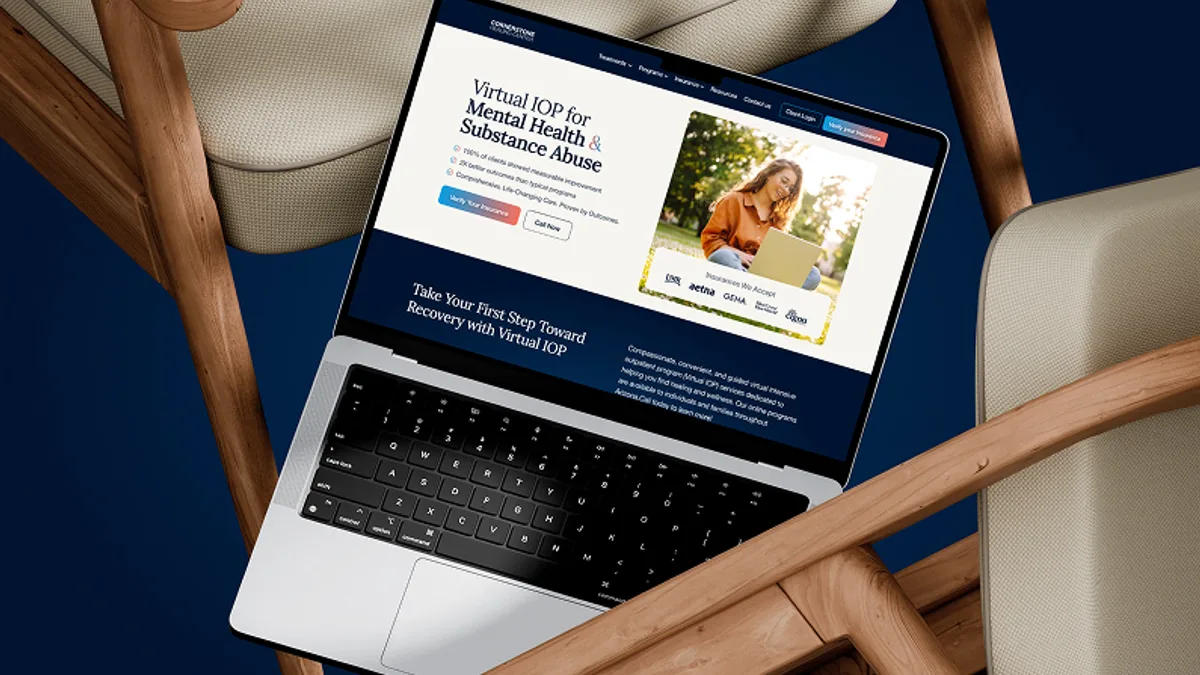
The proof point we lead with: after our redesign, Cornerstone Healing Center saw a 20% increase in website conversions. At the admission economics above, a 20% conversion lift is worth multiples of any tier's annual cost. You can see the work in our case studies and the full breakdown on our pricing page.
Honest fit note: if you need a 40-page multi-location build with deep Salesforce integration on a fixed enterprise contract, a $50,000+ specialist project may fit better. If you need a site that converts, ships fast, and keeps improving monthly without a five-figure invoice up front, that is what we built our model for.
5 questions to ask any agency before signing
These five questions expose 90% of bad website deals before any money moves. Ask them in writing and keep the answers.
- Who owns the domain, site, and code the day we part ways? The only acceptable answer: you do, in full, on final payment.
- Can you itemize this quote? Design, development, content, compliance, and integrations should each carry a number you can compare against the ranges in this guide.
- Will the site be LegitScript-ready at launch? Disclosures, credential displays, and compliant claims should be deliverables, not afterthoughts.
- Which form vendor holds the BAA, and where does PHI live? If the answer is vague, your intake forms are a liability.
- What measurable result did your last treatment center site produce? A real answer sounds like "20% more conversions," with a name attached. A fake one sounds like "great feedback."
The bottom line: expect $5,000–$15,000 for a strong single-location site, $15,000–$50,000 for a custom admissions engine, plus roughly $5,000–$7,000 in first-year compliance costs unique to this industry. Judge every quote against what one admission is worth, and never sign with anyone who will not put ownership and itemization in writing.
Frequently asked questions
Most centers pay $5,000–$15,000 for a professional single-location website and $15,000–$50,000 for a custom build with CRM, call tracking, and insurance verification integrations. Multi-location operators commonly spend $50,000–$120,000. Template builds start around $2,000–$5,000. Add roughly $5,900–$6,300 in unavoidable first-year compliance costs: LegitScript at $4,690 for one facility plus a BAA-covered form tool at $99–$129 per month.
 Recovery
Jun 18, 2026 · 8 min
How to Design an Addiction Recovery Website That Actually Converts
Recovery websites carry more weight than most. Here's how to design for trust, compliance and conversion so the people who need help actually reach out.
 SEO & Growth
Jul 29, 2026 · 16 min
How to Get Recommended by ChatGPT and Google AI in 2026
AI assistants now recommend businesses millions of times a day. Here is the 7-step playbook to make sure yours is one of them.
 Development
Jul 2, 2026 · 15 min
WordPress vs Next.js in 2026: Which Is Right for Your Business Website?
A detailed, no-hype comparison of WordPress and Next.js for business websites: performance, SEO, AI search, cost, security and exactly when to choose each.