
Rehab Marketing Without Buying Leads: How Treatment Centers Fill Beds in 2026

Jul 31, 2026 · 15 min read
Every treatment center operator we speak to opens with the same two sentences. Marketing costs more than it did three years ago. Most of that money buys somebody else's phone number.
The lead vendor model is easy to understand and hard to leave. A call center or a directory ranks for the searches you cannot win, screens the caller, and hands you a warm phone call for a fee. You pay per call or per admission, you can turn the tap up when census drops, and you never have to build anything. That is the pitch, and for a while it holds.
What changed is the exposure. In 2025 the Federal Trade Commission stopped treating deceptive treatment advertising as the marketing company's problem alone and named the clinics that received the steered calls. Federal kickback law reaches people paid per referral, and it is criminal law, not a licensing matter. Meanwhile the certification you need to advertise at all became a fixed annual cost per facility that no vendor relationship removes.
So this is a piece about the other path: the channels you own, what the law actually says, what compliance costs, and the order to build in. One caveat first. We could not verify a credible public benchmark for what aggregator calls cost per admission. The ranges circulating on agency blogs do not show their data, so we are not going to repeat them. Every figure below links to a source you can open yourself.
The 30-second answer
You can fill beds without buying leads, and 2026 is a good year to start. Paying anyone per referral runs straight at the Eliminating Kickbacks in Recovery Act, which carries a fine of up to $200,000 and up to 10 years in prison for each occurrence. The FTC now names treatment providers, not only their marketing vendors, in deceptive advertising complaints. And the replacement channels are cheaper to hold: a free FindTreatment.gov listing, a site that answers the four questions every caller has, local and organic search, and referral relationships structured so nobody is paid by the head. Build them in that order, then measure admissions by source rather than leads by source.
Key takeaways
- Per-referral pay is the risky structure, not marketing itself. The federal exception for employees and contractors only holds when compensation does not vary by the number of individuals referred.
- Buying the call does not buy distance from it. In the FTC's June 2025 complaint against a lead-generation operation, three treatment providers that received the steered calls were named as defendants alongside the call center. Those allegations have not been proven in court.
- Deceptive search advertising now carries a price tag. One provider settled with a $7 million civil penalty, suspended to $1.9 million only because it could not pay, plus a ban on bidding on rivals' names.
- Certification is a floor, not an edge. LegitScript's published pricing is $1,395 to $1,595 per facility to apply and $2,550 to $3,095 per facility every year, and lead generators can be certified under the same program.
- Demand is not the constraint. SAMHSA's 2024 survey counted 52.6 million people who needed substance use treatment and 10.2 million who received it.
- The cheapest channel is the one most centers forget. FindTreatment.gov drew over 5.1 million views in 2025 and a listing costs nothing beyond an annual survey.
- None of this is fast. Plan on a quarter before owned channels carry real census, and keep whatever is working while you build.
What the law says about paying per referral
Federal criminal law prohibits paying or receiving anything of value in exchange for referring a patient to a recovery home or a clinical treatment facility. That is the Eliminating Kickbacks in Recovery Act, 18 U.S.C. 220, passed in 2018. It applies to any health care benefit program, which means commercial insurance and cash pay, not only Medicare and Medicaid. The penalty is a fine of not more than $200,000, imprisonment of not more than 10 years, or both, for each occurrence.
The part that matters for marketing sits in the exceptions. Payments to an employee or an independent contractor are permitted, but only where the compensation is not determined by and does not vary by the number of individuals referred, the number of tests or procedures performed, or the amount billed to the health care benefit program. Read that twice, because it describes almost every business development pay plan in this industry. A salaried outreach coordinator sits inside the exception. The same person on a bonus per admission sits outside it.
In July 2025 the Ninth Circuit gave the statute its first appellate reading in United States v. Schena. The court held that percentage and commission based compensation for marketers is not automatically a violation, and that the statute is not a blanket prohibition on those structures. That was widely reported as good news. It is narrower than it sounds. Falling outside a safe harbor is not the same as being lawful, and the court's point was that such arrangements become unlawful when paired with undue influence over the referral, such as false or misleading statements about the service. If a vendor's call script is doing the persuading, you are relying on somebody else's honesty to stay on the right side of that line.
State law can be stricter, and often is. Florida's Patient Brokering Act, Florida Statute 817.505, makes it a felony to offer or pay a commission, bonus, rebate, kickback or bribe to induce a patient referral. The fine scales with the number of patients involved: $50,000 for fewer than 10, $100,000 for 10 to 19, and $500,000 for 20 or more, with a felony conviction attached at every tier.
We build websites, we are not lawyers, and none of this is legal advice. If you currently pay anyone per call, per lead or per admission, the useful next step is an hour with a healthcare attorney who works in behavioral health, before your next renewal.
Your vendor's ads are your problem now
The FTC has started naming treatment providers as defendants over advertising their marketing partners ran. That single change is why this article exists.
On June 24, 2025 the Commission filed a complaint in the U.S. District Court for the District of Maryland against Mercury Marketing, LLC and others, alleging they used Google search ads displaying the names of specific treatment clinics while routing the resulting calls to a defendant call center, where telemarketers posed as the searched-for clinic or as a centralized admissions office. The FTC alleged the telemarketers claimed clinical professionals had recommended particular facilities after an objective assessment, when in reality they were working on behalf of those facilities. The defendants named include Malibu Detox, LLC, Malibu Recovery Center, LLC and Aliya Health Group, LLC: the providers on the receiving end, listed alongside the marketing company and four individuals. The Bureau of Consumer Protection's director said the defendants "took advantage of consumers searching online for substance use disorder treatment". The case is a complaint, so the allegations are untested.
Two weeks earlier the Commission had settled with a Florida provider over the same tactic. In the settlement announced with Evoke Wellness, the company ran Google ads keyed to rival clinics' names paired with its own call center number, and its telemarketers posed as a centralized admissions office or an addiction hotline. The order imposes a $7 million civil penalty, suspended to $1.9 million because the defendants could not pay the full amount, bans them from using rivals' names in search-engine ads, and requires a compliance program that monitors their call centers for misrepresentations.
Both actions were brought under the FTC Act and the Opioid Addiction Recovery Fraud Prevention Act of 2018, which the Commission says gives it enhanced remedies including civil penalties and consumer refunds specifically for deceptive marketing of substance use disorder treatment. Its advice to businesses in this sector is blunt and free: search your own name and see who is bidding on it.
The practical read for an operator is not that paid search is forbidden. It is that when you buy calls, you inherit the ad copy, the script and the impersonation risk of a company you do not control, and the Commission has shown it will put your legal entity in the caption of the complaint.
What it costs to advertise legitimately
Advertising addiction treatment on the major platforms requires certification, and it is a recurring per-facility cost. Google restricts the promotion of recovery-oriented drug and alcohol addiction services, and only advertisers that have applied and been approved may run them, in a short list of countries: Australia, Canada, France, Ireland, New Zealand and the United States. Services unrelated to drug and alcohol addiction, such as behavioral addiction or nicotine addiction, sit outside that policy.
The approval most US centers need comes through LegitScript, whose addiction treatment certification is recognized by Google, Meta, Microsoft and Nextdoor. Published standard pricing is an application fee of $1,395 to $1,595 per facility and an annual certification fee of $2,550 to $3,095 per facility, with expedited review adding $2,500 per application. The certification verifies 16 core standards covering licensing, legal compliance, staff qualifications, insurance, accurate website content, privacy and transparent advertising.
Here is the part nobody selling you leads will mention: lead generators and recovery support services can be certified under the same program. Certification makes you eligible to compete, it does not make you win. A multi-location operator pays it per facility, every year, and still has to earn the click.
The demand you are actually competing for
Your census problem is a findability problem, not a demand problem. SAMHSA's 2024 National Survey on Drug Use and Health, as summarized by the National Association of Counties, counted 52.6 million people aged 12 or older, 18.2% of that population, who needed substance use treatment in the past year. It counted 10.2 million, or 3.5%, who received it.
Five people needed care for every one who got it. That gap has causes no website can fix: cost, waitlists, stigma, geography, ambivalence. What it does tell you is that no vendor is selling access to a scarce resource. They are selling a shortcut to attention, at a price that resets every month, in a market that is not short of people.
Start with the listing you are probably not using
The cheapest acquisition channel in this industry is a federal directory that costs nothing to join. FindTreatment.gov, SAMHSA's treatment locator, drew over 5.1 million views in 2025. It is also where the FTC sends consumers in its alerts about search-ad scams, which makes it a rare listing actively promoted by the government to exactly your audience.
Getting listed runs through the National Substance Use and Mental Health Services Survey. Facilities must be licensed, certified or otherwise approved by their state substance abuse agency to be eligible, and the survey has to be completed every year to keep the listing live. It takes an afternoon. We have sat with clinical directors who did not know their listing had lapsed, in the same quarter they approved a five-figure lead spend.
Do the same pass on your state's provider locator, your accrediting body's directory, and the in-network directories of every insurer you take. None of these will fill a wing on their own. They are free, they are permanent, and they rank.
Make the site answer the four questions
A treatment center website has one job: answer the four questions a person has at 11pm, before they will pick up the phone. Will my insurance cover this. What happens in the first 24 hours. Who will I actually be talking to. Can I reach a human right now.
Most sites in this category answer none of them above the fold. They lead with a photograph of a beach, a mission statement, and a phone number in small grey type. And the caller is frequently not the patient. It is a mother, a spouse, an adult child who has been carrying this for months and is finally doing something about it at midnight. Write for that person and the question of tone answers itself.
The mechanics that move the number, in the order we build them:
- Insurance, stated plainly and early. Name the carriers you work with. If you verify benefits, say how long it takes and what you need from the caller. Vagueness here reads as expensive.
- One primary action per page. A phone number that is a real tap target on mobile, plus a short form for people who will not call. Not four competing buttons.
- Program pages that describe the day. Levels of care, length of stay, what family involvement looks like, what the room looks like. Photographs of the actual facility, not a stock library.
- Proof that survives scrutiny. Licenses, accreditations and staff credentials with names and faces. Only what you can evidence.
- Speed, and mobile first. This traffic is overwhelmingly phone traffic, often on a poor connection, often late at night.
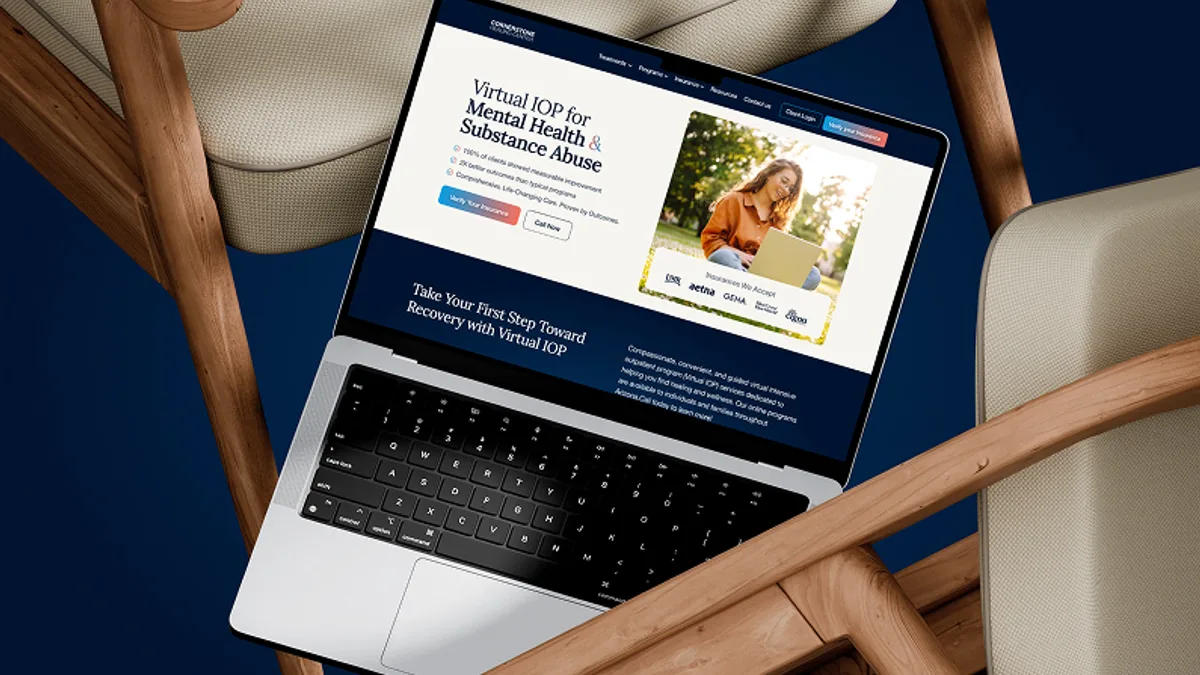
After we redesigned the site for Cornerstone Healing Center, website conversions rose 20%. That is one client and one project, so treat it as a data point and not a forecast. If you want the full costing of a build like that, we published a full cost breakdown for treatment center websites. For the layout detail, our guide to recovery website design goes deeper.
Own the searches you are currently renting
Every dollar paid to an aggregator rents a position you could hold. Three assets do most of that work.
Your own name. Search it. If a competitor or a call center is bidding on your brand, you are paying a middleman for demand that already asked for you by name. Defensive brand bidding is cheap, because your quality score on your own name is excellent, and the FTC order against Evoke Wellness shows how long the alternative remedy takes.
Local presence. A complete Google Business Profile for every location, consistent name, address and phone across directories, and real photographs. Someone searching for treatment near a specific city is further down the funnel than any national keyword you could buy.
The questions that come before the decision. Nobody starts at "rehab near me". They start at whether insurance covers residential treatment, what withdrawal actually feels like, how to tell an employer, whether they can keep their phone. Write those pages honestly, without a sales turn at the end, and they compound. They are also what AI assistants quote back, which is worth building for deliberately. We wrote up how to get recommended by ChatGPT and Google AI separately.
Referral relationships, structured so they stay legal
Referrals are the highest-converting channel in behavioral health and the easiest one to structure illegally. The compliant version is simple: relationships built by salaried people whose pay does not vary with the number of individuals they refer, per the federal exception above.
The relationships worth the calendar time are discharge planners at local hospitals, emergency departments, therapists and psychiatrists in private practice, employee assistance programs, drug courts and probation officers, sober living operators, and your own alumni and their families. None of them need to be paid. They need to know what you actually treat, what you do not, how fast you can accept someone, and that you will call back the same day.
Alumni deserve their own line. A center with a real alumni program has a referral engine no lead vendor can sell, because the person recommending you has nothing to gain. Ask for the review while the gratitude is fresh, make it effortless, and never offer anything of value in exchange for one.
Measure admissions, not leads
Lead counts are the metric a vendor prefers, because they are the metric a vendor controls. Track two things instead. First, cost per admission by channel, calculated across a full quarter so one long stay does not distort it. Second, a single question at intake: how did you first hear about us, asked before anyone mentions a website.
Those two numbers usually tell an uncomfortable story in the first quarter and a clarifying one by the second. Owned channels look terrible in month one because they carry no volume yet, then quietly overtake, because their cost stays flat while their output rises.
What this costs and how long it takes
Being specific about our own numbers, since we ask clients to be specific about theirs. Foundation Partner is a one-time flat fee of $1,499, and Design Partner runs $2,499 per month for ongoing design and development. Two weeks is the typical launch window for a focused build, though a multi-location treatment center with program pages, staff bios and insurance content usually runs longer, because content approvals are the slow part and never the code. We have shipped 200+ projects, and we reply to partnership requests within 48 hours. The full detail is on our pricing page, and our addiction recovery page explains how we approach this sector.
Set that against the annual floor you already pay: certification per facility, plus whatever your current vendor bills. The comparison that matters is not agency cost against zero. It is cost per admission from an asset you own against cost per admission from an asset you rent.
Who should keep buying leads
We would rather say this than take on a client we cannot help. Keep your vendor, at least for now, if any of these describe you.
- You have weeks of runway and need heads in beds this month. Owned channels do not work on that timescale, and anyone who tells you otherwise is not being straight with you.
- You are not licensed, certified or otherwise approved by your state authority. Fix that first. It gates the free directories and the ad certification both.
- Your admissions line is not answered by a trained human seven days a week, including evenings. Every channel in this article ends in a phone call. Improving the front of the funnel while the back of it leaks is the most expensive mistake in this business.
- You want a partner who will guarantee an admission count. We will not, and an agency that does is either buying leads on your behalf or inventing the number.
A 90-day sequence
If you are starting from a site nobody has touched in three years, this is the order we would run it in.
Days 1 to 30. Search your own brand name and document who is bidding on it. Confirm or restore your FindTreatment.gov listing and complete the annual survey. Claim and complete a Google Business Profile for every location. Add the how-did-you-hear-about-us question to intake. Put your current vendor contracts in front of a healthcare attorney.
Days 31 to 60. Rebuild the pages that matter: home, each level of care, insurance and admissions, staff. Publish real photographs and named credentials. Put insurance information where a phone user sees it without scrolling twice.
Days 61 to 90. Publish the first five question-led pages, one for each real question your admissions team hears every week. Start the referral calls, five conversations a week, from a salaried person. Pull the first cost-per-admission-by-channel report and hold it next to your vendor invoices.
None of it is clever. All of it is yours, and next quarter it will still be there without a renewal.
Frequently asked questions
Buying advertising is legal. Paying for a referral is where criminal exposure starts. The Eliminating Kickbacks in Recovery Act prohibits paying or receiving anything of value in exchange for referring a patient to a recovery home or clinical treatment facility, with a fine of up to $200,000 and up to 10 years in prison per occurrence, and its exception for employees and contractors only holds where pay does not vary by the number of individuals referred. Whether a specific per-call or per-admission contract crosses that line depends on the actual agreement, which is a question for a healthcare attorney rather than a marketing agency.
 Recovery
Jul 30, 2026 · 15 min
Addiction Treatment Center Website Cost in 2026: Real Numbers
Quotes run from $500 to six figures for a rehab website. Here is the real 2026 range, the compliance line items nobody quotes, and the admissions math.
 Recovery
Jun 18, 2026 · 8 min
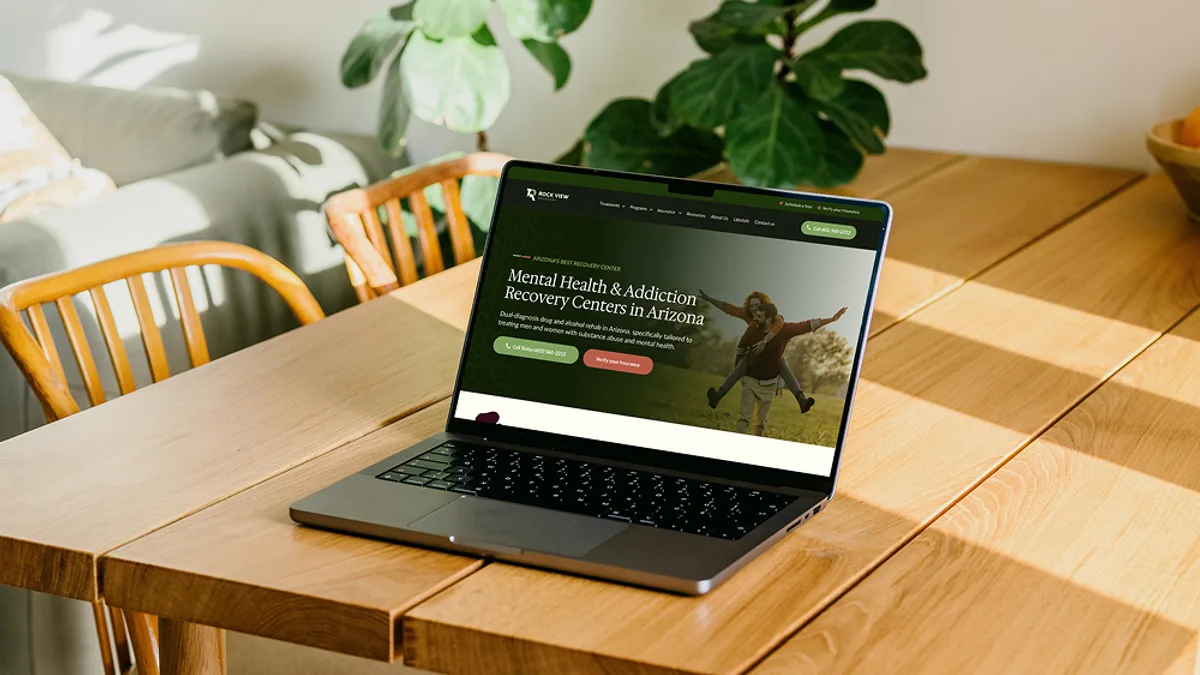
How to Design an Addiction Recovery Website That Actually Converts
Recovery websites carry more weight than most. Here's how to design for trust, compliance and conversion so the people who need help actually reach out.
 SEO & Growth
Jul 30, 2026 · 14 min
Website Traffic But No Leads? How to Find the Leak and Fix It
4,000 visitors, three form fills, two of them spam. Here are the six places leads actually leak, in the order worth testing, with the data behind each one.