
How Much Should a Private School Website Cost in 2026?

Aug 26, 2026 · 16 min read
Apptegy sells websites to schools and publishes what it charges on one page: $7,500 plus $3.80 per student, per year. That second half is the part almost every cost guide leaves out, and it is the part that matters. It means the identical product costs a 150 student school $8,070 a year and a 1,500 student school $13,200. It also means that any answer arriving as a flat range is answering a question this market does not actually price.
We went looking for that number on twelve other vendors' sites on 26 August 2026 and mostly did not find it. What follows is every price we could read on a seller's own page, our own arithmetic wherever a published formula had to be applied, and the federal rules that decide what your site has to carry before anybody argues about the photography. Disclosure, since it shapes everything below: we build websites, schools included, so treat what follows as a price list written by one of the companies you might be comparing.
The 30-second answer
A private school website in 2026 is priced two incompatible ways. Specialist school platforms fold the site into an annual subscription that scales with enrollment, and the one vendor that publishes its rate charges $7,500 plus $3.80 per student a year, with a one-time $9,500 plus $700 per organization on top. Agencies and general web shops quote a project fee instead, and the largest school vendor's own guide puts a theme-based school site at $5,000 to $25,000 and a custom one at $35,000 to $75,000. We sell monthly partnerships instead, from $1,000 a month, with every price published and no minimum. The useful answer is a formula, not a range, and no two quotes are comparable until each is converted to a cost per enrolled student.
Why the published ranges cannot all be right
They cannot all be right because they are describing different products at different scales and presenting the result as one number. Searching for what a school website costs on 26 August 2026 returned a first page that was mostly about tuition rather than about websites. The guides that are about websites tend to give a range with no source attached, and the ranges do not agree with each other or with the prices the vendors themselves publish.
The deeper problem is that a range assumes the price is a property of the website. In this market it is frequently a property of the school. A vendor that charges per student is not quoting you for a set of pages. It is quoting you for a license whose cost is set by your enrollment figure, which means two schools can buy the same templates, the same content management system and the same mobile app and pay amounts that differ by thousands of dollars a year. A range cannot express that, so it hides it.
The one vendor that publishes a formula
Apptegy publishes an actual formula, and reading it tells you more about school website pricing than any guide we found. Its Foundations package, headed Website and Mobile Apps, is listed at $7,500 plus $3.80 per student as a yearly cost, and covers the platform, an integrated website and content management system, student information system integration, text and voice alerts, email notifications, native iOS and Android apps, push notifications, training and support. Setup and development is charged separately as a one-time cost of $9,500 plus $700 per organization.
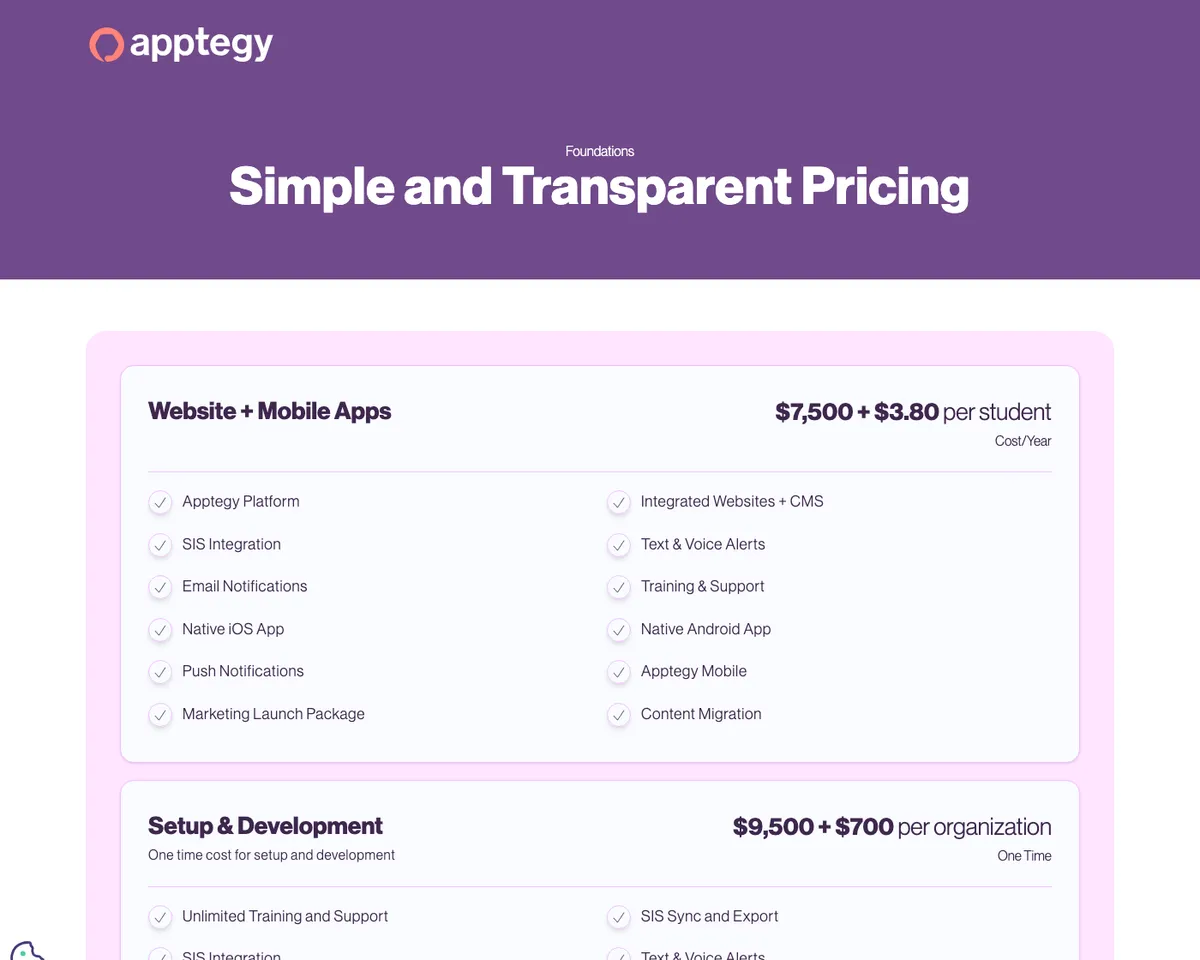
Apply the annual half of that formula to four schools and the shape of the market appears. A school of 150 students pays $8,070 a year. At 400 students it is $9,020. At 800 it is $10,540, and at 1,500 it is $13,200. Those are our sums on the vendor's published rate, not quotes we were given.
Notice what the chart does not do. Between the smallest school and the largest, enrollment rises tenfold and the annual bill rises by about 64 percent. If you are the head of a small school reading a guide that says school websites cost between eight and thirteen thousand dollars, you will conclude you are being quoted normally. You are, and you are also paying for a price floor that was built for someone else.
What that same contract costs per student
Divided by the students it covers, the same contract costs a small school just over six times what it costs a large one. At 150 students the annual figure works out to $53.80 per student. At 400 it is $22.55, at 800 it is $13.18, and at 1,500 it is $8.80. The product does not change. The unit price collapses because the fixed $7,500 keeps being spread across more people.
Add the one-time charge and the gap widens further. For a single school buying setup and development at $9,500 plus $700 for one organization, year one is $18,270 at 150 students and $23,400 at 1,500 students, which is $121.80 and $15.60 per student respectively. The per student figure is the one to carry into a board meeting, because it is the only version of the price that survives a comparison against a competing quote. A trustee at a 400 student school who asks whether $19,220 is a lot for a website has asked an unanswerable question. The same trustee asking whether $48.05 per student in year one is a lot has asked one you can answer.
What 13 vendors will tell you before you call
Most of them will tell you nothing. On 26 August 2026 we requested the pricing page of thirteen companies that sell websites to schools: Apptegy, Blackbaud, Digistorm, Edlio, Finalsite, Foxbright, Gabbart, Juniper Education, Morweb, SchoolBlocks, SchoolStatus, Sycamore and Veracross. Two of them publish a price a visitor can read. Six have no pricing page we could find from their own navigation or at the usual addresses. Three ask you to request a quote instead of showing a number. One puts its pricing page behind a login. One returned an error to us.
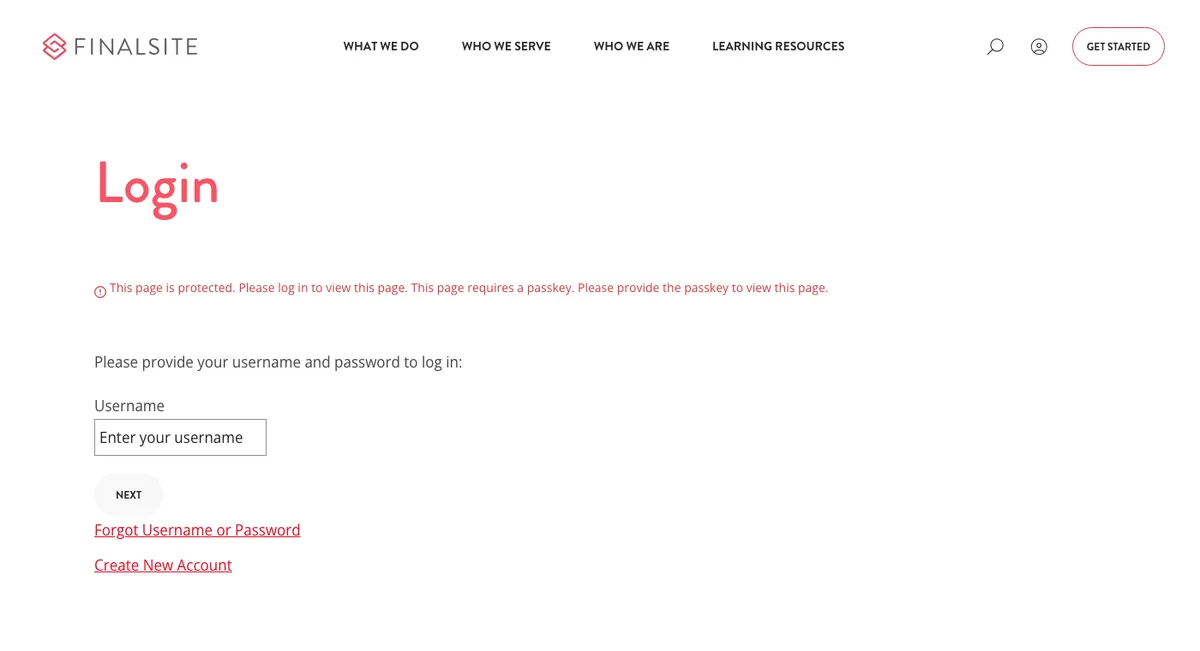
The vendor behind the login is the biggest name in the category, which makes its page worth seeing. Finalsite has a pricing page at the address you would expect, and that page asks for a username and a passkey.
Blackbaud takes the opposite approach and answers the question directly in a frequently asked questions block on its own pricing page, under the heading "Why doesn't Blackbaud list pricing on the website?" Its stated answer is that each organization has different needs, so it prepares a personalized quote. Elsewhere in the same block it says pricing is based on several factors including the organization's size and its number of users. Veracross describes its pricing as customized and tailored to each school. SchoolNow and Campus Suite, two brands we started the exercise treating as separate vendors, both now redirect their pricing addresses to one SchoolStatus product page with no prices on it, which is its own small lesson about how quickly this supplier list consolidates.
We are not claiming any of this is sinister. Enterprise software is often sold this way, and a school with three campuses genuinely does need a different contract from a single-site Montessori. But it does mean the buyer carries the whole burden of comparison, and it means the two published prices in the chart above are doing an enormous amount of work for everyone else's benchmarking.
What the largest vendor's own cost guide says
Finalsite publishes a long article answering exactly the question in this headline, and it is a good deal more useful than most, with one revealing gap. It opens by saying the honest answer is that it depends, then does something better than most competing guides and explains what the answer depends on: design scope, interior page templates, campaign landing pages, integrations, hosting, security and strategic consulting.
Where it becomes interesting is the numbers it does give. A theme-based school website is put at $5,000 to $25,000. A custom site with consulting, multiple design rounds and content strategy is $35,000 to $75,000. Enterprise sites for large districts or schools running multiple microsites go up to $150,000 and beyond. It also prices its alternatives: freelancers are put at $2,000 to $50,000, do-it-yourself hosting at $100 to $500 a year, a domain and certificates at $50 to $100 a year, and an in-house developer to maintain the result at $45,000 to $75,000 a year.
| Route | What Finalsite's own guide puts it at |
|---|---|
| Do it yourself: hosting | $100 to $500 a year |
| Do it yourself: domain and certificates | $50 to $100 a year |
| Freelance designer or small studio | $2,000 to $50,000 |
| Theme-based school website | $5,000 to $25,000 |
| Custom site with consulting and content strategy | $35,000 to $75,000 |
| Enterprise, large district, multiple microsites | Up to $150,000 and beyond |
| In-house developer to maintain it | $45,000 to $75,000 a year |
Every figure in that table describes a way of buying a website. None of them describes what Finalsite charges. The company that publishes the most detailed cost guide in this category prices the freelancer, the do-it-yourself route and the in-house hire, and keeps its own number behind the login in the screenshot above. That is only a fair thing to point out if we do better, so ours are on our pricing page and in the section below.
One line in that guide is the most important sentence in this article, and it is Finalsite's, not ours. Explaining that some companies bundle design cost into the software subscription, it notes that the upfront design may be partly or fully included depending on your enrollment. The largest vendor in the category is telling you, in its own words, that the number of students you have moves the price of your website.
The bills your website generates but does not contain
The website line item is usually the smallest number a school signs, and the systems attached to it are also priced per head. This is where a build decision turns into a recurring cost that lands on families rather than on the school, which is why it belongs in the same conversation as the design brief.
Tuition payment plans are the clearest case. Holy Family Regional Catholic School publishes its options on its own site: paying in full carries no fee, a two-payment plan carries a $10 fee, and the ten-payment plan carries an annual fee of $45. That $45 is charged to each family every year and paid by the family, not the school. Two hundred families on the ten-payment plan generate $9,000 a year in plan fees, which is more than the entire per student half of the Apptegy contract at a school of 1,500.
The same rail carries the school's own charges. St. Pius X Catholic High School publishes a non-refundable enrollment fee of $400 per student billed through its FACTS account. Academy of Holy Angels publishes a fee schedule with a re-enrollment charge of $350 for upper school and $300 for middle school, a technology fee of $850 and $750, capital maintenance at $500 and $250, fundraising at $500 and $250, textbook fees at $275 and $150, plus graduation fees. None of that is website spending. All of it is money that moves because a page on a website collected a signature and an account number, which is exactly why the intake path deserves more design attention than the homepage hero.
The parent organization has its own subscription. Membership Toolkit, which sells to parent teacher organizations and booster clubs rather than to schools, publishes three annual plans at $550, $850 and $1,150, with text messaging billed at $2.50 a month plus two cents per message after a free allowance. Morweb, which counts schools among its markets, publishes its nonprofit tiers at $149 and $199 a month. Those are the realistic reference points for the smaller site that sits beside the school's, and they are useful precisely because so few school vendors will show you one.
The rule whose deadline passed in April
If any part of your site is aimed at children under 13, or you know you are collecting personal information from them, the amended Children's Online Privacy Protection Rule has applied in full since 22 April 2026. The Federal Trade Commission published the amendments on 22 April 2025 at 90 FR 16918. They took effect on 23 June 2025, and the rule text gave regulated entities until 22 April 2026 to comply, with three narrow exceptions.
Two of the amended provisions are website deliverables rather than policy documents in a drawer. 16 CFR 312.10 now requires a written data retention policy setting out why children's personal information is collected, the business need for keeping it and a timeframe for deleting it, and it requires that policy to appear in the notice on the site itself. That is a page somebody has to write, publish and keep current. 16 CFR 312.8 requires a written information security program with a named coordinator, risk assessments at least annually, safeguards designed against those risks, regular testing, and written assurances from any third party you let touch children's data. Your web vendor is a third party you let touch children's data.
There is a gap here that most summaries get wrong. In 2024 the Commission proposed adding definitions of a school and of a school-authorized educational purpose, along with a school authorization route to consent, and then declined to finalize any of it. The stated reason is that the Department of Education signaled its own plans to amend the FERPA regulations, and the Commission did not want the two to conflict. So the tidy provision letting a school consent on parents' behalf is not in the rule. If a feature on your site collects data from a child under 13, do not assume the school can wave it through, and get an answer from your own counsel before you build it.
Whether student privacy law applies to you at all
For most independent schools, FERPA does not apply, and this surprises people. The regulations set their own scope at 34 CFR 99.1: they cover an educational agency or institution to which funds have been made available under a program administered by the Secretary of Education. A private K-12 school that takes no such funds is outside that definition. Public districts are squarely inside it.
For the schools it does cover, the provision that shapes a website is 34 CFR 99.37. Publishing directory information is permitted only after the school has given public notice of three things: which categories it has designated as directory information, that a parent or eligible student may refuse to let any or all of those categories be designated, and how long they have to say so in writing. A photo gallery, an honor roll, an athletics roster and a graduation list are all directory information disclosures. The rule adds a detail worth building for: opt-outs made while a student was enrolled must still be honored after they leave, unless the former student rescinds them.
Two practical consequences follow, and they apply whether or not FERPA reaches you. First, a content management system that cannot flag an individual student as excluded from photographs is a system that will force somebody to police it by memory. Second, if you are outside FERPA, the duty does not vanish, it just moves into your enrollment contract, your state's student privacy statute and the promises your own privacy policy makes. Read all three before your vendor writes the photo release copy for you.
Accessibility, in one paragraph
Private schools are named in the statute, and religious ones are named in the exemption. The ADA's list of public accommodations at 42 U.S.C. 12181(7)(J) includes a nursery, elementary, secondary, undergraduate or postgraduate private school. 42 U.S.C. 12187 then exempts religious organizations and entities controlled by religious organizations from that subchapter, which is why a parochial school and the independent day school across town can face genuinely different exposure. The dated federal web deadline that has been in the news applies to public entities rather than to either of them, and we set out what it does and does not cover in our piece on what actually protects you from a website accessibility lawsuit. Build to WCAG 2.1 AA regardless: families using assistive technology are reading your admissions pages either way.
What we charge, and when we are the wrong choice
We sell three monthly partnerships, $1,000, $2,500 and $5,000 a month, and our pricing page sets out what each one includes. Pause or cancel anytime, and there is no minimum. Once your content and brand assets are in hand, a focused build is typically live in 14 business days, and a partnership request gets an answer inside 48 hours. More than 200 projects have gone out of this studio.
Now the part that costs us work. If you need a directory of 90 faculty profiles synchronized from your student information system, a parent portal with role-based permissions, mass notification by text and voice, and a mobile app in two stores, a specialist school platform will serve you better than we will, and the per student subscription this article has been picking at is what pays for those integrations. If your school is large, that subscription is also cheap per student. Buy it.
Come to us when the site is a marketing and admissions problem rather than an operations problem: when inquiries stall, when the tuition and financial aid pages cannot be found, when the application handoff drops families, or when you already own a portal that works and simply need a front door that converts. That is the work we did for Cornerstone Healing Center, where a redesign produced 20 percent more website conversions, and for Eden Digital, which grew revenue tenfold after we rebuilt its site. Neither is a school, and we would rather say that than imply otherwise.
The decision aid: convert every quote to a price per student
Do this before you compare anything, because it is the only step that makes two school website quotes mean the same thing. Take each proposal, add up what it will actually cost you across three years including one-time charges, divide by three, then divide by your current enrollment. Write the answer in dollars per student per year. It takes about fifteen minutes and it will reorder your shortlist.
Four rules keep the arithmetic honest. Use your real enrollment, not your target, because that is the number the invoice will use. Put the one-time charges in, spread across the term you actually expect to keep the site, since a $10,200 setup fee is a different animal over three years than over eight. Include anything the contract makes mandatory, such as hosting, support and required training, and exclude anything genuinely optional. And note next to each figure which parts move when enrollment moves, because that column is your forecast for the year you add a grade.
| Fill this in | Vendor A | Vendor B | Vendor C |
|---|---|---|---|
| One-time charges | |||
| Annual fixed charge | |||
| Annual per student charge | |||
| Your enrollment | |||
| Three-year total | |||
| Cost per student per year | |||
| Which parts rise if you grow 20 percent |
Worked on the only published formula we have, a 150 student school lands at $76.47 per student per year across three years, and a 1,500 student school at $11.07. Those come from a one-time $10,200 plus three annual charges, added up and divided twice. Any quote you are holding can be pushed through the same two divisions. If a vendor will not give you enough detail to complete the row marked annual per student charge, that refusal is itself a data point, and you should ask a second time in writing.
What we would build first, and in what order
Build the pages that carry a decision before the pages that carry a feeling. Across the 200 plus projects we have shipped for businesses where an inquiry has a season, the ordering that survives contact with a real calendar looks like this.
Tuition and financial aid comes first, as text on a page rather than a downloadable document, because it is the page families search for by name and the one we most often find hiding in a PDF. Then the inquiry and tour booking path, tested end to end on a phone, since a form that hands over to a portal login is where enrollment funnels leak. Then the program pages, one for each grade band or subject that a family would search separately. Then faculty, with real credentials, because a skeptical parent reads it. Then events and deadlines, editable by your admissions office without a developer, because a stale open house date in October does more damage than a dated homepage. Everything else can wait for version two.
The decisions that turn out to be expensive later are the ones about ownership and portability rather than about aesthetics. Before you sign, establish who holds the domain, who holds the content and whether you can export it, which we have written about at length in what to check before you sign a web design contract. On a per-student subscription that renews every year, the cost of being unable to leave compounds quietly, one enrollment figure at a time.
Frequently asked questions
It depends on your enrollment, because much of this market is priced per student rather than per project. The one specialist vendor that publishes its rate charges $7,500 plus $3.80 per student a year, plus a one-time $9,500 and $700 per organization, which works out to $8,070 a year for 150 students and $13,200 for 1,500. The largest school vendor's own guide puts a theme-based site at $5,000 to $25,000 and a custom one at $35,000 to $75,000. Ours is a monthly rate, $1,000, $2,500 or $5,000 a month, published in full, and you can pause or cancel anytime.
Most of them sell a contract whose value depends on your size, so they quote rather than list. Of thirteen school website vendors we checked on 26 August 2026, only two published a price a visitor could read, six had no pricing page we could find, three had a quote form with no numbers, and one required a login. Blackbaud answers the question directly on its own pricing page and says it prepares a personalized quote because each organization's needs differ.
Often, yes. Apptegy publishes $3.80 per student per year alongside a $7,500 fixed charge, and Finalsite's own cost guide notes that design work may be partly or fully included depending on your enrollment. The practical effect is that a small school pays a much higher unit price for the same product: on that published formula, $53.80 per student a year at 150 students against $8.80 at 1,500.
It applies if part of your site is directed to children under 13 or you know you are collecting their personal information, and the amended rule has been fully in force since 22 April 2026. Two requirements are build items: 16 CFR 312.10 requires a written data retention policy published in the notice on your site, and 16 CFR 312.8 requires a written security program with a named coordinator and annual risk assessments. The proposed school authorization route to consent was not finalized, so do not assume the school can consent for parents.
Usually not. Under 34 CFR 99.1 the regulations apply to institutions that receive funds under a program administered by the Secretary of Education, and most independent K-12 schools do not. For schools it does cover, 34 CFR 99.37 requires public notice and an opt-out before directory information such as photos, honor rolls and athletics rosters can be published. If FERPA does not reach you, the duty moves into your enrollment contract, state law and your own privacy policy.
Private schools are listed as places of public accommodation at 42 U.S.C. 12181(7)(J), which brings them within ADA Title III. Religious organizations and entities they control are exempted by 42 U.S.C. 12187, so a parochial school and an independent day school can face different exposure. Build to WCAG 2.1 AA either way, because families using assistive technology read your admissions pages regardless of which statute applies.
Convert each one to a cost per enrolled student per year before you look at anything else. Add every charge across the term you expect to keep the site, including one-time fees, divide by the number of years, then divide by your current enrollment. Note which parts of each quote rise when enrollment rises, because that column tells you what happens the year you add a grade. If a vendor will not tell you the per student component, ask a second time in writing.
Build the tuition and financial aid page as real text on the page, not as a PDF. It is the page families search for by name and the one most often buried. After that, the inquiry and tour booking path tested on a phone, then a page per program or grade band, then faculty profiles with real credentials, then events and deadlines your admissions team can edit without a developer. A stale open house date costs you more than an unfashionable homepage.
 Web Design
Sep 6, 2026 · 17 min
SaaS Website Cost in 2026: What 1,953 Agencies Say They Charge
Every published range for this question is written by an agency describing its own invoices. So we read all 196 pages of Webflow's Certified Partner directory and counted what 1,953 of them actually put on the card.
 Web Design
Sep 5, 2026 · 17 min
Template or Custom Website in 2026: What a Template Actually Buys
We read the license and the support policy behind the biggest template marketplace, then counted every theme in the WordPress.org directory and the Shopify Theme Store. The sticker price is the smallest number in the decision.
 Web Design
Sep 3, 2026 · 19 min
How Much Should a Hotel Website Cost in 2026?
Published platform prices run from $9 to $197 a month and a managed hotel website starts at $14,400 a year. Then a federal rule decides which number on your page has to be the biggest.