
Ecommerce Website Cost in 2026: The Percentages Nobody Adds Up

Aug 20, 2026 · 15 min read
Ask what an ecommerce website costs and page one hands you a range. BigCommerce's own guide to the question opens with $0 to $250,000 or more. Elementor's puts a do-it-yourself store at $300 to $1,000 for the first year and an agency build at $10,000 to $50,000 or more. Neither range is wrong, exactly. They are just wide enough to contain a weekend project and a distribution business, which makes them useless for deciding anything.
There is a better question, and the platforms answer it themselves, in public, on the same pages that advertise the monthly fee. An online store does not have one price. It has a fixed part and a part that moves with your sales, and the moving part is written in percentages. Add those percentages up on a single order and the figure is larger than most owners expect. Follow them upward and you reach published thresholds where the bill changes without anybody asking you first.
Every number below was read on 20 August 2026 from the page of the company that charges it. Where a figure is calculated, the arithmetic is shown. We build ecommerce sites for a living, so this is a page written by one of the suppliers you would be pricing, and it is fair to read it that way.
The 30-second answer
Two numbers decide what an online store costs and only one of them appears in a quote. The fixed part is the build, the platform subscription and hosting: on annual billing Shopify runs $19 to $299 a month, BigCommerce $29 to $299, Squarespace $12 to $25, and WooCommerce charges nothing at all for the software. The moving part is a set of percentages taken from every order: card processing at around 2.9%, a platform fee of up to 2% for using a payment provider the platform did not pick, and app fees stacked on top of both. On one $100 order those three can come to $6.88. The fixed part is the number in the quote. The moving part is the one that grows.
Why this matters more than it used to
Online selling is now a large enough share of retail that the percentages are attached to real money. The Census Bureau reported on 18 August 2026 that United States retail ecommerce sales for the second quarter of 2026 were $340.2 billion once adjusted for seasonal variation, up 12.2% on the same quarter of 2025 against 6.7% growth for retail as a whole. That quarter's ecommerce total was 17.1% of the $1,986.5 billion of retail sales.
The number that matters to a single store is smaller and sharper. Take a business selling $250,000 a year online. At 6.39%, which is what the layered configuration further down this page comes to, the percentages take $15,975 before anyone counts the cost of the goods. At 2.9%, which is the same sale with no platform fee and no per-transaction app, they take $7,250. The $8,725 between those two figures says nothing about the business itself. That gap is the residue of choices made before launch, while everybody was still arguing about the homepage.
What the platforms charge you to exist
Start with the part everybody quotes, because it is the smallest. Shopify's published plans on annual billing are Basic at $19 a month, Grow at $49, Advanced at $299 and Plus from $2,300. Paying monthly instead costs $25, $65 and $399 for the first three. Shopify states plainly that there are no setup fees on any plan, and its point of sale upgrade is a separate $89 a month per location.
BigCommerce publishes four self-service tiers on annual billing: Core at $29 a month, Growth at $79, Scale at $299 and Performance from $1,499. Its monthly-billing equivalents are $39, $105 and $399. Squarespace, which is a website builder that sells commerce rather than a commerce platform, publishes three plans at $12, $17 and $25 a month on annual billing, or $19, $27 and $36 monthly. Wix lists Light at $17, Core at $29, Business at $39 and Business Elite at $159 a month on yearly terms, with a note on the same page that the dollar figures are shown for reference only and that prices vary by location, which is why nothing further in this article rests on them.
One aside is worth the detour, because it shows how the ranges on page one get made. BigCommerce's guide to ecommerce cost puts platform hosting on a software-as-a-service platform at $80 to $730 a month. BigCommerce's own pricing page prices its three self-service plans at $29, $79 and $299 on annual billing. A company can be the best available source for its own prices and a poor one for the category, and the two pages sit on the same domain.
So the subscription question is answered in a paragraph, and for a small store the difference between the cheapest and the most expensive mainstream plan is a few hundred dollars a year. That is not where the money goes.
The cut nobody adds up
Every online sale is skimmed at least once, by the processor, and it can be skimmed three times. Stripe publishes 2.9% plus $0.30 for domestic cards, with no setup or monthly fee, plus 1.5% for international cards and another 1% where a currency conversion is needed. PayPal's United States rate card puts its own checkout at 3.49% plus a fixed fee, and standard credit and debit card payments at 2.99% plus a fixed fee. Those are the unavoidable ones.
The second cut is the one that surprises people, because it is charged by the platform rather than by anybody handling the money. Shopify charges a third-party transaction fee when you use a payment provider other than Shopify Payments, and the rate falls as you move up: 2% on Basic, 1% on Grow, 0.6% on Advanced and 0.2% on Plus. BigCommerce charges the same kind of fee under a different name, the Open Payment Provider fee, at 2.0% on Core, 1.0% on Growth and 0.6% on Scale, and it says in its own footnote that the fee is billed by BigCommerce to you rather than to your shoppers and appears as a separate line on the invoice, on top of whatever your provider charges.
Squarespace runs a third variant, charging an online store transaction fee of 2% on its Basic plan and 0% above it, with digital content and memberships charged at 7%, 5% and 0% across the three tiers.
The top row is a real configuration: a Shopify Basic store using an outside gateway and one subscription app. The percentage components are 2.9%, 2% and 1.49%, which is 6.39%, and the fixed components are $0.30 and $0.19, so a $100 order leaves $93.12. Drop the app and it is 4.9% plus $0.30, or $5.20. Move the same order onto BigCommerce Core with Stripe and the platform fee disappears entirely, leaving $3.20. Nothing about the store changed in those three rows. The bill more than doubled on configuration alone.
How the platform fee goes to zero
The two platforms take different routes to zero and the difference is worth knowing before you pick one. Shopify's fee exists to move you onto Shopify Payments, so the way to avoid it is to use Shopify Payments. Its card rate is not printed on the pricing page and Shopify says only that the rate depends on your plan, which means the largest recurring percentage in the whole model is the one the pricing page does not print.
BigCommerce takes the opposite approach and names its exceptions. Orders processed through what it calls Embedded Payment Providers carry no fee at all, and it publishes the list: BigCommerce Payments, Adyen, Affirm, Afterpay, Amazon Pay, Bank of New Zealand, Checkout.com, Clearpay, Fortis, Global Payments, Klarna, PayPal Braintree, PayPal Complete Payments, PayPal Wallet, Bluesnap, Bankful, Sezzle, Stripe, TD Online Mart, Worldpay and Zip Money. Twenty-one names, Stripe among them, and each order is attributed to whichever provider processed it, so a store running everything through one of those pays nothing. BigCommerce also publishes a floor for card processing itself, saying the fee for debit and credit cards begins at 2.89% plus $0.29 across all its plans, with American Express at 3.50% and no fixed fee.
That is a real and checkable difference between two platforms that get compared on subscription price alone. On one of them the 2% is a toll for choosing your own processor. On the other it disappears if you pick a provider from a published list. Settle that question before you choose the platform, not after.
The price that goes up by itself
Here is the part the cost guides leave out, and it is printed on the plan cards. BigCommerce ties each self-service tier to a sales ceiling and moves you up when you cross it. The Core card says the plan auto-upgrades to Growth. The Growth card says the same about Scale. Neither of the two guides quoted at the top of this article mentions it, and one of them is published by BigCommerce.
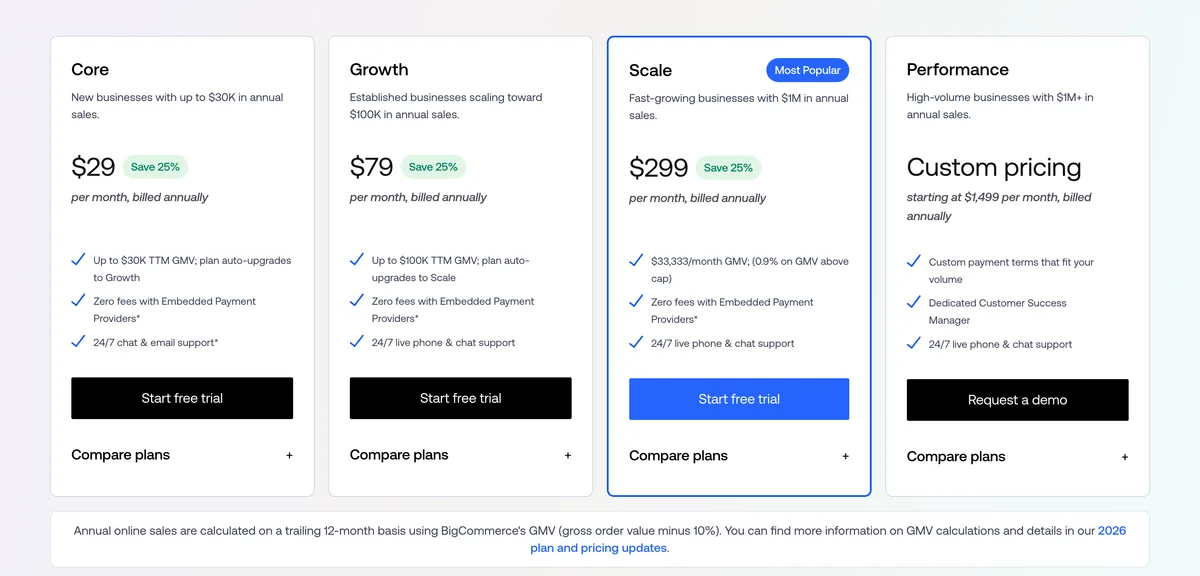
The thresholds are $30,000 and $100,000 of trailing twelve month gross merchandise value, and the footnote defines that value as gross order value minus 10%, so in sales terms the moves land at about $33,333 and $111,111. Scale is metered rather than capped: it covers $33,333 a month of gross merchandise value and charges 0.9% on anything above that, and once trailing twelve month value reaches $2 million the account moves to Performance. The company's own answer on how automatic upgrades work says you are notified and then upgraded.
Read that as a pricing model rather than as a complaint. It is defensible, it is disclosed, and the alternative is a hard cap that breaks your store on a good week. But it means the honest answer to what a BigCommerce store costs is not a number. It is a function of your sales, and you can plot it.
What crossing one line costs
The chart above assumes a store using a payment provider outside the embedded list all year, and it prices only the platform, not the processing. At $30,000 of sales the bill is $348 of subscription plus 2% of $27,000 in gross merchandise value, which is $540, so $888 for the year. At $60,000 the store is on Growth: $948 plus 1% of $54,000, which is $1,488. At $110,000 it is still on Growth, at $948 plus $990, or $1,938.
Then it crosses. At $120,000 of sales the store sits on Scale, and the arithmetic is $3,588 of subscription plus 0.6% of $108,000, which is $648, for a total of $4,236. Ten thousand dollars of extra sales, an increase of about 9%, has taken the annual platform bill from $1,938 to $4,236. It more than doubled.
The effect fades as the store grows into the plan. At $250,000 of sales the same store pays $4,938, and at $500,000 it pays $6,738, which includes $450 of the published 0.9% overage on the gross merchandise value above $33,333 a month. As a share of sales that is 3.5% at the crossing point and 1.3% at half a million. The bill is not unreasonable at either end. It is just that the worst moment to be on this pricing model is the month you outgrow a tier, and nobody plans for that because nobody plots it.
The apps take a percentage too
The third layer is the one that turns a tidy budget into a surprise, because store owners tend to think of apps as software subscriptions when several of them are priced like payment processors. Search the Shopify App Store for subscriptions and it returns 787 apps. On the first page of those results every listing but one showed a free entry label, free to install or free plan available, rather than a price. That label describes the cost of switching the app on, which is not the same thing as the cost of running it.
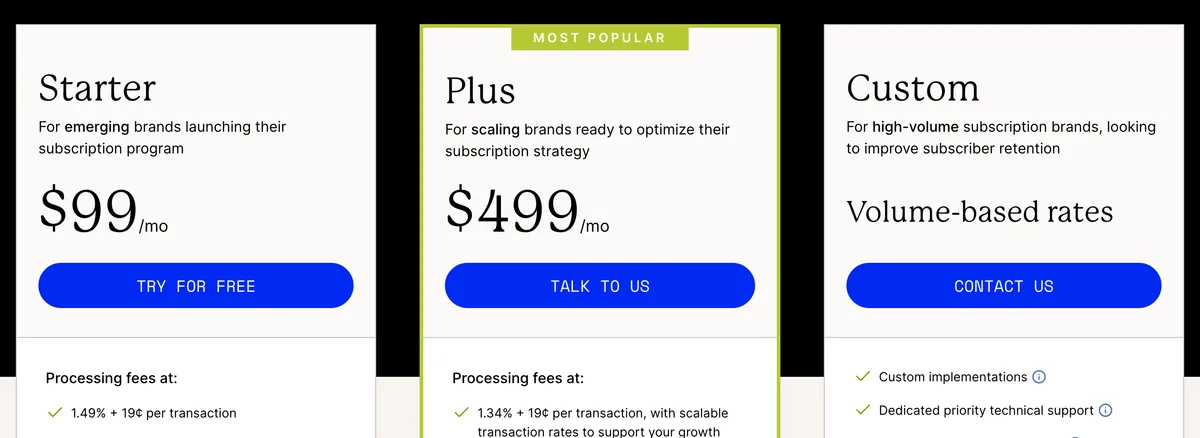
Recharge publishes two plans. Starter is $99 a month plus 1.49% and 19 cents per transaction. Plus is $499 a month plus 1.34% and 19 cents. Its own pricing FAQ states that this sits on top of anything else the store pays, naming the ecommerce platform, the payment processor and other applications. That is a vendor telling you, correctly and in writing, that its percentage stacks on the others.
The lesson generalizes past this one company. When you evaluate an app, find the transaction line before you look at the monthly line, because on a growing store the transaction line is the larger of the two. A store putting $20,000 a month through a 1.49% app pays about $298 in percentage fees, plus 19 cents on every order, against a $99 subscription. The subscription was never the price.
The route where the bill does not move
The alternative is to buy the software once and rent only the infrastructure. WooCommerce publishes its position on its own pricing page: the platform is free and open source, with no platform fee and a stated 0% revenue share. It puts hosting at $25 to $350 a month for most stores and extensions at $29 to $299 a year each, bought individually rather than bundled into a tier.
Two honest caveats belong here. Free software is not a free store: the hosting, the extensions and somebody competent to run all of it still cost money, and we have set out what that ongoing bill actually contains in the four bills behind one number. And this route hands more responsibility to you, which is a real cost even when no invoice arrives for it.
Worth noticing while you are on that page: WooCommerce's comparison table lists Shopify Basic at $29 a month and BigCommerce Core at $29 a month with online revenue capped at $50k. Checked against each company's own pricing page on the same day, Shopify Basic is $19 on annual billing or $25 monthly, and BigCommerce Core's published ceiling is $30,000 of trailing twelve month gross merchandise value. Comparison tables written about competitors go stale, including the ones published by companies large enough to know better, which is the whole argument for reading the vendor's own page and dating what you read. The same discipline applies when you are checking an agency, and we have written that method out in what to check before you call.
On the design layer, the cheapest honest number in ecommerce is a theme. The Shopify Theme Store lists 1,210 paid themes, and the first page of them runs $100 to $500, paid once. A theme is not a design and it will not solve a positioning problem, but a store with no budget and no traffic yet should almost certainly buy one and spend the difference on stock and ads.
Every percentage that can attach to one order
This is the page to keep. Each row is a separate charge with its own rate, its own invoice line and its own way of going to zero, and none of them is hidden: all seven were read off the vendors' own pages in an afternoon.
| The cut | Charged by | Published rate on 20 August 2026 | What makes it zero |
|---|---|---|---|
| Card processing | Your payment processor | Stripe lists 2.9% plus $0.30 for domestic cards | Nothing. This is the cost of taking money and every route pays it |
| Third-party payment provider fee | Shopify | 2% on Basic, 1% on Grow, 0.6% on Advanced, 0.2% on Plus | Use Shopify Payments, which is the point of the fee |
| Open Payment Provider fee | BigCommerce | 2.0% on Core, 1.0% on Growth, 0.6% on Scale | Use any of the 21 providers on its embedded list, Stripe among them |
| Volume overage | BigCommerce | 0.9% of gross merchandise value above $33,333 a month on Scale | A contracted Performance plan, which starts at $1,499 a month |
| App transaction fee | The app vendor | Recharge lists 1.49% plus 19 cents on Starter | Do without the app, or pick one that charges a flat fee |
| Digital goods fee | Squarespace | 7% on Basic, 5% on Core, 0% on Advanced | Move up a plan, which costs $13 a month more |
| Revenue share on the software | WooCommerce | 0%, stated on its own pricing page | Already zero. You pay for hosting and extensions instead |
Two things follow from reading the table as a whole. Only the first row is genuinely unavoidable, because somebody has to move the money. Every other row can be taken to zero, or close to it, by a decision made in the first two weeks of the project, which is exactly when nobody is thinking about fractions of a percent.
What the money should actually buy
All of the above prices the plumbing. It says nothing about whether the store sells anything, and that is the part a design budget can move. Baymard Institute, which has run large scale checkout usability research for years, puts the average documented cart abandonment rate at 70.22%, calculated across 50 separate studies.
The reasons are more useful than the headline. In Baymard's quantitative study of United States shoppers, 42% said they had abandoned a cart because they were only browsing, which no amount of design will fix. Set that group aside and the distribution looks like this.
Extra costs being too high leads at 40%, followed by slow delivery at 20%, not trusting the site with card details at 19% and being asked to create an account at 18%. A checkout that was too long or complicated and a site that had errors or crashed tie at 17%. Then an unsatisfactory returns policy at 13%, not being able to see the total cost up front at 12%, a declined card at 10%, too few payment methods at 9%, and 7% who did not know.
Our reading of that list, offered as a judgment rather than as a finding of Baymard's: at least five of those eleven describe something on the page rather than something about the business. Extra costs arriving late in the flow, a forced account, a checkout with too many steps, a total you cannot see until the last screen, and a payment method you do not offer are all build decisions. Baymard's own measurements make the third one concrete: an ideal checkout flow can run to 12 to 14 form elements, or 7 to 8 counting only the fields, while the average United States checkout in its benchmark database shows 23.48 elements by default, 14.88 of them fields.
That is the argument for spending the money on the store rather than shaving the subscription. Cutting a checkout from 23 form elements to 14 is a fixed cost, paid once. Two extra points of fee is a percentage, paid on every order for as long as the store exists. And a shipping charge that only appears on the last screen is working against the single most cited reason on that chart.
Where we fit, and who should not call us
We build ecommerce sites, and the three monthly partnerships we sell are set out on our pricing page: $1,000, $2,500 and $5,000 a month, pause or cancel anytime, with everything we deliver yours to keep. The prices are published there rather than agreed in conversation, so you can hold them against the rest of this article before you call. The outcome we cite most often is 20% more website conversions, measured after a treatment center rebuild for Cornerstone Healing Center, and we have shipped more than 200 projects.
Several kinds of reader should not hire us, and saying so is more useful than a disclaimer. If you have not sold anything yet, buy a theme, take the entry plan, and find out whether people want the product before you commission anything. If your store already converts well and simply looks dated, the money is better spent on stock, photography or acquisition, and a rebuild will feel productive without being profitable. If the actual problem is that nobody knows the store exists, that is a traffic problem and a different specialist solves it more cheaply than we would.
Where a build earns its cost is when the checkout is the constraint: a store with traffic and a poor conversion rate, a catalog that has outgrown its template, a migration off a platform whose percentages have started to hurt, or a business that needs the site to explain something considered and expensive before anyone will buy. On ownership of what you end up with, which matters more on ecommerce than anywhere else because the store is the business, read what to check before you sign.
Price the store you expect to be
Here is the exercise, and it takes about twenty minutes with last year's sales figure in front of you. Do not model the store you are running today. Model the one you expect in two years, run the same arithmetic back to where you are now, and look hard at what happens in between.
Write down three annual sales numbers: what you did in the last twelve months, three times that, and ten times that. For each of the three, work out four lines. One, the platform subscription at the tier those sales require, remembering that BigCommerce measures the threshold on gross order value minus 10% and moves you across at about $33,333 and $111,111 of sales. Two, the platform's percentage on order value, which is zero if you use Shopify Payments or a provider from BigCommerce's embedded list, and up to 2% if you do not. Three, card processing at your processor's published rate, around 2.9% plus 30 cents unless you have negotiated. Four, every app that charges per transaction, at its own percentage.
Then look at the gaps between the three columns rather than at the totals. If the bill roughly triples when sales triple, you are on a model that scales with you and the decision is simply whether you like the product. If it jumps by more than the sales did, you have found a threshold, and you now know the sales figure at which it fires, which is enough to plan a migration a year early instead of discovering it on an invoice. Either way you will have priced the store rather than the quote, which is more than any range on page one can tell you.
Frequently asked questions
It costs a fixed amount plus a percentage, and the percentage is the part most quotes leave out. On annual billing the mainstream platform subscriptions run from $12 to $299 a month, and a paid Shopify theme costs $100 to $500 once. On top of that, every order is charged around 2.9% plus 30 cents by a card processor, up to 2% more by the platform if you use an outside payment provider, and a further percentage by any app that prices per transaction. A single $100 order can leave $93.12 after those three.
It depends almost entirely on how you take payments, not on the subscription. The entry plans are close, at $19 and $29 a month on annual billing. The difference is the fee for using an outside payment provider: Shopify charges 2% on Basic and removes it only if you use Shopify Payments, while BigCommerce charges 2.0% on Core but publishes a list of 21 embedded providers, including Stripe, that carry no fee at all. Answer the payments question first and the platform question mostly answers itself.
It is a percentage Shopify charges you for processing an order through a payment provider other than Shopify Payments. The published rates are 2% on Basic, 1% on Grow, 0.6% on Advanced and 0.2% on Plus. It is charged on top of whatever your payment provider charges, so a store on Basic using an outside gateway pays that 2% in addition to card processing of roughly 2.9%.
Yes, and it says so on the plan cards. Core covers up to $30,000 of trailing twelve month gross merchandise value and then moves the account to Growth, and Growth covers up to $100,000 before moving it to Scale. Because BigCommerce defines that value as gross order value minus 10%, the moves land at roughly $33,333 and $111,111 of sales. Scale is metered instead, covering $33,333 a month with 0.9% charged above it, and accounts reaching $2 million move to Performance.
The software is free and WooCommerce publishes a 0% revenue share, but the store is not. Its own pricing page puts hosting at $25 to $350 a month for most stores and extensions at $29 to $299 a year each, and you still pay a card processor. What you avoid is the platform's cut of your sales, which is why the route appeals to stores whose volume has grown faster than their need for hand holding.
Budget for the transaction line rather than the monthly line, because on a growing store it is bigger. Recharge, a widely used subscription tool, publishes $99 a month plus 1.49% and 19 cents per transaction on its entry plan, and states that this is charged in addition to your platform and processor fees. At $20,000 of monthly volume that app's percentage comes to about $298, plus 19 cents an order, against a $99 subscription.
Baymard Institute puts the average documented rate at 70.22%, calculated across 50 separate studies. In its own survey of United States shoppers, 42% said they abandoned because they were only browsing. Among the rest, extra costs being too high leads at 40%, then slow delivery at 20%, distrust of the site with card details at 19% and a forced account at 18%.
Use a template until the store has proven demand. Paid themes in Shopify's own store number 1,210, with the first page priced between $100 and $500 as a one-time purchase, which is a rational buy for a business that does not yet know what sells. A custom build earns its cost later, when the checkout or the catalog is the thing limiting sales, when a template can no longer carry the range, or when migrating off a platform whose percentages have started to matter.
 Development
Sep 7, 2026 · 17 min
Staffing Agency Website Cost in 2026: What 46 Agency Sites Actually Run
We measured 46 staffing agency websites and found that a staffing firm is buying two websites, not one. Here is what each half costs, who supplies it, and which one carries your legal obligations.
 Development
Sep 2, 2026 · 17 min
How Much Should a Mortgage Broker Website Cost in 2026?
Published plans run from $619 to $12,963 in the first year, and the design is not what separates them. On a lending site the rules decide the copy, the layout and how long you keep every version.
 Development
Aug 31, 2026 · 17 min
How Much Should a Church Website Cost in 2026?
The website is the cheap part. Tithely publishes one at $19 a month and Planning Center gives one away. The expensive part is the 2.15% to 3.00% coming off every gift the site collects, which is worth $2,465 a year on a $250,000 offering.