
How Much Should an Auto Repair Shop Website Cost in 2026?

Aug 29, 2026 · 16 min read
Shop Marketing Pros sells auto repair shops a website for $699 a month. Read the small print under the price and it says the agreement runs 18 months, after which the bill falls to $199 a month and the site becomes yours. Nobody advertises it this way, but those two numbers together are the only place in this market where the price of building an auto repair website is actually published. Five hundred dollars a month, for 18 months, is $9,000.
That figure does not appear on any page ranking for this question. What appears instead is a range, usually $3,000 to $8,000, sometimes $500 to $25,000, always uncited. This article is built the other way round: from the prices vendors print on their own pages, read on 29 August 2026, plus the arithmetic those prices imply. We sell websites too, so our numbers are in here with everyone else's.
The 30-second answer
Almost nobody in this market sells an auto repair shop a website as a project. Every vendor we found that publishes a price sells a subscription, and those published prices run from $49 a month to $699 a month. At the bottom, Cannone Marketing charges $199 to set up and $49 a month with no contract. In the middle, Tamarack Media Group starts at $100 a month billed month to month, and Shop Boss folds a website into the third tier of its shop management software, $100 a month above the tier below it. At the top, Shop Marketing Pros charges $499, $599 or $699 a month on an 18 month agreement, then $199 a month once the site is paid off. Back the build price out of that last one and it is $5,400, $7,200 or $9,000 depending on page count. Over three years the published routes cost between $1,963 and $16,164. We sell a monthly partnership too, at $1,000, $2,500 or $5,000 a month, published and with no minimum.
The numbers at the top of Google
They disagree by a factor of fifty, and not one of them cites a vendor's published price. On 29 August 2026 we opened the guides returned for this query and wrote down the headline number each one leads with. Qrolic splits the market into three bands, $500 to $2,500 for do it yourself, $3,000 to $8,000 for a professional build and $10,000 to $25,000 and up for multiple locations, then summarizes the whole thing as $500 to $25,000. XSOne Consultants puts the average at $2,000 to $5,000 and itemizes it down to $300 to $500 for making the site work on a phone. FreshySites says $2,500 to $7,000.
A shop owner who reads all three learns that a website costs somewhere between five hundred dollars and twenty five thousand. That is the question restated, not answered. And the shape of the answer is wrong in a way the size of the range hides: every one of those figures prices a project, a thing you buy once. In this trade the working parts of a site, the booking, the inspection links, the review requests, the payment page, are billed monthly by whoever owns your repair orders. Stop counting at the build and you have stopped before the bill that never ends.
Everyone who publishes a price sells a subscription
We could not find a single company selling auto repair websites that publishes a one time build price. We did find five that publish a monthly one, and the spread between them is fourteen to one.
Cannone Marketing is the floor: $199 to set up and $49 a month after that, cancel any time, with a custom homepage demo built before you pay. Its own page explains the price by pointing at what it does not carry, no office, no sales floor, no account managers, and it names the going rate it is undercutting as $3,000 to $5,000 up front plus $150 to $400 a month. Tamarack Media Group starts at $100 a month, month to month, no long term contract, covering design, hosting, updates and local search work, and also builds a working demo before payment. Two vendors, both offering to show you the site before you spend anything, which tells you something about how much trust there is to win in this market.
The three larger numbers all come from companies that sell auto repair shops something else as well. That is the pattern worth understanding, and it is where the real money is.
The build price you can back out of a published rate
Shop Marketing Pros publishes three website tiers and, next to each one, the price after the agreement ends. Essential is $499 a month for 10 custom written pages. Pro is $599 for 20 pages. Top-Tier is $699 for 30. All three carry an 18 month agreement, and all three fall to $199 a month afterwards. The feature list above the cards says the site is 100% yours after completing 18 months of payments
.
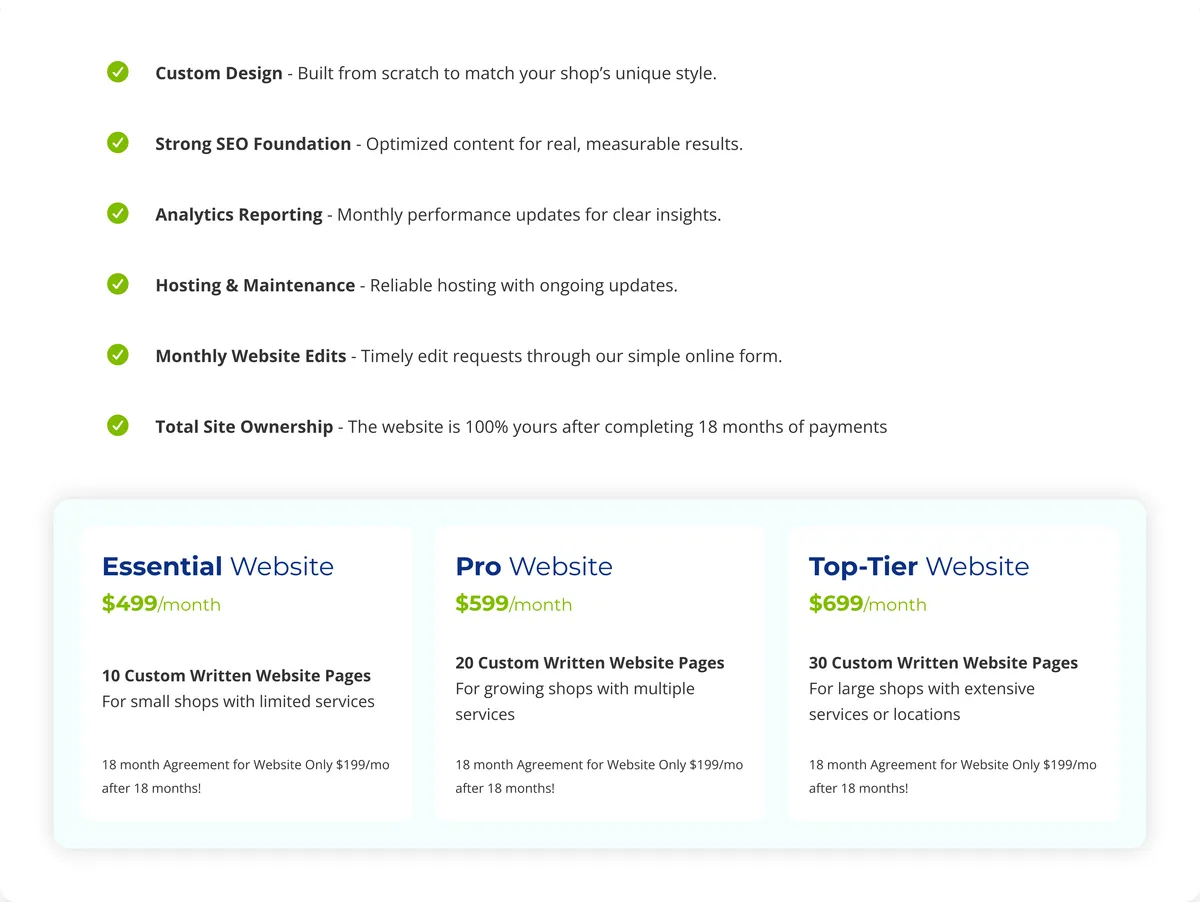
Subtract and the structure falls out. The part of the bill that stops after 18 months is $300, $400 and $500 a month. Multiply by 18 and you get $5,400, $7,200 and $9,000. That is the build, financed. The $199 that continues is hosting, maintenance, monthly edits and analytics reporting, which is roughly what the rest of the industry charges for the same job and close to what we found when we looked at what website maintenance actually pays for.
The same $500 a month appears in the company's four bundled packages, which all include what it calls a Top-Tier website. Website with a Plan is $1,598 a month and then $1,098. Car Count Booster is $2,497 and then $1,997. The Top-Tier is $3,396 and then $2,896. Legacy Builder is $5,295 and then $4,795. Four packages, four different totals, one identical $500 drop at month 19. The page is not perfectly consistent about the after-term figures, printing $1,098 in one block and $1,099 in another for the same package, and $2,896 and $2,899 for another, which is the sort of thing that happens when a number is maintained by hand in two places.
Two things follow from this that matter more than the price itself. The first is that a monthly website bill with a fixed term is a financing arrangement, and financing has a term you can be inside. The second is the ownership line. If the site is yours after 18 months of payments, the natural reading is that it is not yours in month nine, which is the exact question we spent a whole article on in who owns your website. Ask what happens if you leave early, and get the answer in writing before you sign, not after.
At two vendors the website is a software tier
The cheapest website in this market with a real published price is not sold by a web company at all. It is a $100 a month step up inside shop management software.
Shop Boss sells four tiers. Gold is $199 a month, Platinum is $349, Premier is $449 and Premier Plus is $649, all month to month, with annual billing at $179, $314, $404 and $584. What Premier adds over Platinum, and the only thing it adds beyond one to one training, is a responsive website, website design, website maintenance, monthly website reporting and a quarterly website review. So a Shop Boss customer already paying $349 can have a website designed, built, hosted and maintained for another $100 a month, or another $90 on annual billing. Whether that site is any good is a separate question. The price is not a range and it is not a quote.
Tekmetric does the same thing one layer out. Its plans are $199, $349 and $439 a month with no website in any of them, and its Marketing add-on is $345 a month per shop on top of a plan. That add-on is where the site lives: Tekmetric's own websites page describes a search optimized site with online booking built in, appointments landing straight in the shop calendar, plus reminders, campaigns and review collection. The cheapest published Tekmetric configuration that includes a website is therefore $199 plus $345, or $544 a month.
Neither AutoLeap nor Shopmonkey lists a website in any tier of its published comparison. AutoLeap does sell an AI receptionist for $99 a month, which answers the phone rather than the site. Torque360 sells a $999 appointment scheduler add-on that puts booking on a site you already own.
Three vendors, one price list
Once you start reading shop management pricing pages, the striking thing is not that they hide numbers. It is how closely the ones that publish agree.
Tekmetric, AutoLeap and Shop Boss all charge $199 a month for their entry tier and $349 for the tier above it, to the dollar. At the top they part company by ten dollars: Tekmetric's Scale is $439 and AutoLeap's Elite and Shop Boss's Premier are both $449. All three discount annual billing to $179 and $309 or $314. Shopmonkey sits about twenty percent above the pack at $239, $399 and $499. R.O. Writer publishes $199 a month for its Essentials tier and $299 for the tier above, both described as first year prices.
We are not suggesting anything improper. Three companies converging on the same round numbers is what usually happens when a market is competitive, visible and mature, and every one of these firms can see the others' pages as easily as we can. The useful consequence for a shop owner is that the monthly software number is close to fixed. If three vendors want $349 for the middle tier, negotiating that line is not where your effort belongs. Where they differ is in what the tier contains, and that is where a website quote either makes sense or does not.
What the ladder does not include
Three things sit outside the headline price at most of these vendors, and all three are the sort of number that shows up on an invoice months after the decision.
Seats. Shop Boss, Tekmetric and AutoLeap all advertise unlimited users and unlimited repair orders. Shopmonkey does not: Basic includes three user licenses, Clever four and Genius five, with each additional user $20 a month. A seven person shop on Genius pays $499 plus $40, so $539 a month against Shop Boss's $449 for the equivalent tier. The gap widens every time you hire.
Add-ons. Tekmetric charges $70 a month per shop for multi-shop management and $39 a month per shop for its tire suite, both on top of a plan. Shop Boss sells its CRM and online service scheduler as a $249 a month add-on, or you take Premier Plus at $649 and get them bundled. Shopmonkey's card reader is $249 plus $10 a month per device, and its online and in person payment rates are not published at all.
Getting your history out. Shop Boss publishes what it costs to bring data in: $399 to transfer customers and vehicles, $899 to transfer customers, vehicles, repair history and inventory, against more than 130 built in transfer routes. Read that as the price of leaving as well as arriving, because the shop you switch to will quote you the same kind of number. It is also the reason the software choice and the website choice should not be made on the same afternoon by the same salesperson.
What three years actually costs
Monthly prices are hard to compare because the terms are different. Here is every published route in this article priced over 36 months, using each vendor's own monthly figures and nothing else.
| Route | How it is billed | 36 months |
|---|---|---|
| Cannone Marketing | $199 setup plus $49 a month, no contract | $1,963 |
| Tamarack Media Group | $100 a month, month to month | $3,600 |
| Shop Boss Premier over Platinum | $100 a month more than the tier below | $3,600 |
| Tekmetric Marketing | $345 a month per shop, plus a plan | $12,420 |
| Shop Marketing Pros Essential | $499 for 18 months, then $199 | $12,564 |
| Shop Marketing Pros Pro | $599 for 18 months, then $199 | $14,364 |
| Shop Marketing Pros Top-Tier | $699 for 18 months, then $199 | $16,164 |
| KhanWork Foundation Partner | $1,000 a month, pause or cancel anytime | $36,000 |
These are not equivalent products and the table would be dishonest if it pretended otherwise. The Tekmetric and Shop Marketing Pros rows carry search work, campaigns, reporting and, in Tekmetric's case, online booking wired into the appointment book. The $49 and $100 rows are a site, hosting and edits. Our row is the dearest on the table, and like the Cannone and Tamarack rows it carries no term: it is a monthly subscription you can pause or cancel at any point, so $36,000 is what three uninterrupted years would come to rather than anything you sign up for. It does not include hosting, which we do not bill for and which a shop can buy for a few dollars a month.
What the table does show is that among the shop website vendors the decision is not four figures against five figures, it is roughly $2,000 against roughly $16,000 over the same three years, and the difference is mostly marketing services rather than the website. That is a completely reasonable thing to buy. It is not a reasonable thing to buy by accident because it arrived inside a website quote.
The word free on your website is regulated
Nearly every auto repair site in America offers something free: a brake inspection, a check engine light scan, a courtesy shuttle, a quote. The Federal Trade Commission has a published guide about exactly that word, it has existed since 1971, and it contains hard numbers almost nobody in this trade has read.
16 CFR 251.1 sets out how a free offer has to work. Subsection (c) says every term, condition and obligation attached to the free item should appear clearly and conspicuously at the outset of the offer, in close conjunction with it, and it names the workaround it will not accept: putting the conditions in a footnote reached by an asterisk is not disclosure at the outset. That is a design instruction. A hero band reading FREE BRAKE INSPECTION with an asterisk pointing at small print in the footer is the exact pattern the guide rules out.
Subsection (h) is the one that surprises people.
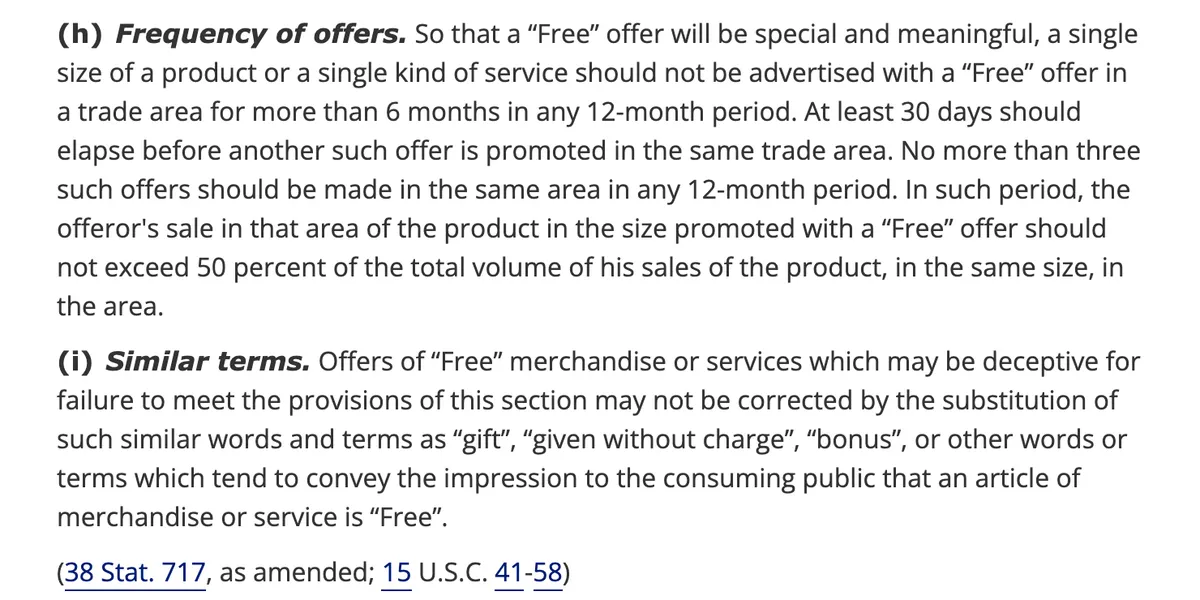
A single kind of service should not be advertised with a free offer in the same trade area for more than six months in any twelve, at least thirty days should pass before the next one, and there should be no more than three such offers in a year in that area. A permanent free inspection banner, sitting on the same page for three years, is not what the guide contemplates. Subsection (i) closes the obvious escape route: swapping in gift, bonus or given without charge does not fix an offer that does not meet the rest of the section. Subsection (b)(2) adds that a regular price only counts as regular if you have actually been selling at it, openly and actively, for something like thirty days.
Two honest caveats. This is a guide, not a rule carrying its own penalties, and it interprets the deception provisions of the FTC Act rather than standing alone. And enforcement in this area lands far more often on national advertisers than on a five bay shop. But the guide is what a regulator, a competitor or a state attorney general reaches for, and the fix is free: put the conditions next to the offer, in the same type, on the same screen, and rotate the offer instead of leaving it up forever.
The warranty sentence on almost every shop site
Somewhere on most independent shop websites is a line saying that using them will not void your factory warranty. The claim is broadly right, it is worth making, and the usual wording overstates it.
The law behind it is the Magnuson-Moss Warranty Act. Section 2302(c) stops a warrantor conditioning a written or implied warranty on the consumer using a branded article or service, unless that article or service is provided free under the warranty or the FTC has granted a waiver. The FTC's own guide for businesses gives worked examples of both. Requiring a specific brand of filter to keep a warranty alive is prohibited. Disclaiming coverage for damage that a non-authorized third party actually caused is permitted, and the guide prints a model sentence doing exactly that.
The consumer facing version on the FTC site is blunter: a dealer cannot deny warranty coverage because someone else did the routine maintenance or repairs, and using aftermarket or recycled parts does not end the warranty. But the same page carries the exceptions. If the warranty says the work will be done at no charge, the manufacturer can choose the facility. If it says the parts are free, the manufacturer can choose the parts.
So the accurate sentence for a shop website is narrower than the one most shops use. Servicing here does not void a factory warranty, and we document every job so the record stands up if a claim is ever questioned. That is defensible. We guarantee your warranty stays intact no matter what is not, because the shop does not control the warrantor's response to damage it believes the shop caused. While you are rewriting that paragraph, note the FTC's flat statement elsewhere that there is no standard warranty on repairs, which means your own repair warranty is a genuine differentiator and belongs on the page in writing.
What an online estimate legally is
If your site has a get a quote or instant estimate widget, find out what your state calls the thing it produces before you build it. In California it is a regulated document.
Business and Professions Code 9884.9 requires a registered automotive repair dealer to give the customer a written estimated price for the labor and parts a specific job needs. No work may be done and no charges may accrue before the customer authorizes it, and nothing above the estimate may be charged without consent obtained after the shortfall is discovered and before the extra work happens. Consent to an increase can arrive by email, which is the section quietly acknowledging that this conversation now happens on a phone. Body and collision work has to be itemized further, with each crash part identified as original equipment or aftermarket.
There is an exception worth designing around. Under subsection (e) a written estimate is not required for defined preventative maintenance if the service is free or if its total price is displayed conspicuously to the customer at the facility. A published, honest price list is the thing that removes paperwork, not the thing that creates it.
The advertising side sits in 9884.7, which lets the director discipline a registration for making any statement, written or spoken, that is untrue or misleading, or that reasonable care should have shown to be untrue or misleading, and separately for false promises likely to induce a customer to authorize work. Your website is written, it is a statement, and everything on it is covered. Section 9884.6 makes operating without a valid registration unlawful in the first place, which is why the registration number belongs in the footer rather than nowhere.
California is one state, and we are not going to publish law we have not read for the other forty nine. The transferable point is that in this trade the estimate is a legal instrument, so the estimate flow is the highest risk thing on the site and the one to design last, carefully, with your own board's current rules open.
Set against a shop's payroll
The website bill is small compared with the payroll it is supposed to keep busy, and the arithmetic is worth doing once so the argument moves off the quote.
In the fourth quarter of 2025 there were 86,552 private establishments in general automotive repair in the United States, employing 397,377 people at an average weekly wage of $1,227, according to the Quarterly Census of Employment and Wages. Widen to automotive repair and maintenance as a whole and it is 176,403 establishments, 1,023,816 employees and $15.0 billion of wages in that single quarter. The average general repair shop in those figures has between four and five people on the payroll.
At $1,227 a week the average worker in that industry costs about $5,317 a month in wages alone. The most expensive published website subscription in this article, $699 a month, is 13 percent of that. The cheapest, $49, is under one percent. The $9,000 build price we backed out of the 18 month term is a little over two months of one employee. None of that is an argument for spending carelessly. It is an argument that the interesting question is whether the site fills bays, not whether the quote says $4,000 or $6,000.
The prices we publish
Having spent an article on other people's pricing pages, here is ours. We sell a monthly partnership and nothing else, at $1,000, $2,500 or $5,000 a month, billed monthly in advance with no minimum and no term. Pause or cancel anytime, and what we build is yours to keep. A focused build usually reaches launch around 14 business days after content and assets arrive, which is a pattern across the 200 plus projects we have shipped rather than a promise, and partnership inquiries get an answer inside 48 hours.
What is not in that number is the software. We do not sell or resell shop management systems and we take no margin on any of them. If you want online booking that writes into your repair order system, that capability is sold by Shop Boss, Tekmetric or Torque360 at their published rates and the invoice has our name nowhere on it. We think that split is the right way round, and it is also why our number can be flat.
Some shops should not hire us, and it is cheaper for everyone if we name them here. Anyone who wants the website, the ads, the reviews and the repair orders arriving on one invoice should buy from a shop management platform or a full service automotive marketing firm rather than from us. If your monthly budget for all marketing is under a hundred dollars, one of the $49 and $100 subscriptions above will serve you better than we will. Shops that need cars this month more than they need a better site should put the money into Local Services Ads and come back to the website later. The full price list is on the pricing page.
Back out the build price before you sign
Every monthly website offer with a fixed term contains a hidden build price, and you can extract it in about two minutes with the numbers the vendor already gave you. Do it before you sign, because the answer changes how the deal reads.
Fill this in from the quote in front of you, not from memory.
| Line | What to write down | Yours |
|---|---|---|
| 1 | Monthly price during the agreement | |
| 2 | Monthly price after the agreement ends | |
| 3 | Length of the agreement, in months | |
| 4 | Line 1 minus line 2, the part that stops | |
| 5 | Line 4 times line 3, the build price you are financing | |
| 6 | Any setup or onboarding fee, once | |
| 7 | Line 5 plus line 6, what the site really costs to build | |
| 8 | Line 2 times 12, the annual bill that never stops |
Then ask four questions, in this order. What happens to line 5 if I cancel in month nine, do I owe the balance, and who owns the site at that moment. Is line 2 guaranteed in writing, or does the price simply revert to line 1 unless I remember to ask. What is included in line 2, hosting and edits and reporting, or hosting alone. And who holds the domain registration, the hosting login and the analytics property, because those three are the difference between owning a website and renting one.
If the vendor will not put line 2 and its start date in the agreement, line 5 is not a build price, it is just a bigger subscription with a nicer story. If they will, you now have the number every guide on this subject declined to publish, for your own quote, from your own vendor. Run the same worksheet against a flat build plus a hosting bill and the two are finally comparable.
What to pay for first
Spend on what a driver with a warning light on the dash needs at 7am, and defer the rest until those work. For a repair shop the order is unusually clear.
First, the facts, correct and structured: hours including the ones that differ, address and which entrance to use, phone number that rings in the bay area, what you do and do not work on, whether there is a shuttle or a loaner, and what happens if the car will not start. This is the cheapest thing on the list and it is what both Google and an AI assistant read when someone asks which shop near them can look at a transmission today.
Second, the one service you actually want more of, on its own page, in the words customers use rather than the ones on the repair order. Diagnostics, brakes, fleet work, European, whatever the shop is built around. Write the price policy on that page, including the estimate process, because that is the paragraph that turns a nervous first time caller into a booked appointment.
Third, a way to get in touch that matches what you can actually deliver. Real booking writes into your repair order system and is sold by your software vendor at $249 or $345 a month or bundled into a $649 tier. If that is not in the budget this year, say so and build an honest request form that a person answers within the hour. A fake booking button that quietly emails the front desk is worse than no button, because the customer thinks they have an appointment.
Fourth, your offers, written to the rules above. Conditions next to the offer in the same type, an accurate warranty sentence, an estimate flow that matches your state's law, and your registration number where an inspector could find it. Everything after that, the photography, the video of the bay, the team page, is worth real money once these four work and worth nothing while the phone number is wrong. Shops in adjacent trades face an almost identical bill structure, which we broke down for the heating and cooling business in what an HVAC company website costs.
Frequently asked questions
Published prices in this market are monthly, not one-off, and they run from $49 to $699 a month. Cannone Marketing charges $199 to set up and $49 a month with no contract. Tamarack Media Group starts at $100 a month, month to month. Shop Boss includes a website in its $449 Premier tier, $100 above the tier below it. Tekmetric bundles a site with online booking into a $345 a month Marketing add-on. Shop Marketing Pros charges $499, $599 or $699 a month for 18 months and then $199. Our own plans are monthly and published too, at $1,000, $2,500 or $5,000 a month with no minimum.
Because the guides price a project and the market sells a subscription. Qrolic splits the answer into $500 to $2,500, $3,000 to $8,000 and $10,000 to $25,000 and up. XSOne Consultants says $2,000 to $5,000. FreshySites says $2,500 to $7,000. None of them cites a vendor's published figure, for the understandable reason that dedicated auto repair website companies almost never print one. The nearest thing to a real project price we could find had to be backed out of a subscription with a fixed term.
Subtract the after-term monthly price from the during-term monthly price and multiply by the number of months in the term. Shop Marketing Pros publishes $499, $599 and $699 a month on an 18 month agreement, each falling to $199 afterwards. The parts that stop are $300, $400 and $500 a month, so the builds are $5,400, $7,200 and $9,000. Its feature list says the site is 100% yours after completing 18 months of payments, which is the same arithmetic told a different way.
At two vendors, yes. Shop Boss puts a responsive website, website design and website maintenance in its Premier tier at $449 a month, against $349 for the Platinum tier below it, so the marginal price of the site is $100 a month. Tekmetric puts a website with built-in online booking inside its Marketing add-on at $345 a month per shop, on top of a plan starting at $199. AutoLeap and Shopmonkey do not sell a website at any tier.
It is billed by whoever owns your repair orders, not by your web designer. Shop Boss sells a CRM and online service scheduler as a $249 a month add-on, or bundled into Premier Plus at $649 a month. Tekmetric includes 24/7 online booking in its $345 a month Marketing add-on. Torque360 sells an appointment scheduler for your own site as a $999 add-on. A form that emails the front desk is a message, not a booking, because only the software that owns the calendar can write a real appointment into it.
Yes, if the conditions travel with the offer and the offer does not run forever. The FTC guide at 16 CFR 251.1 says every term and condition should appear clearly and conspicuously at the outset, in close conjunction with the offer, and states plainly that an asterisk pointing to a footnote is not disclosure at the outset. Subsection (h) adds that a single kind of service should not carry a free offer in the same trade area for more than six months in any twelve, that at least thirty days should elapse before the next one, and that there should be no more than three such offers in a year. Calling it a gift or a bonus instead does not cure a defective offer.
A careful version of that sentence is accurate. Section 2302(c) of the Magnuson-Moss Warranty Act stops a warrantor from conditioning a warranty on the use of a branded part or service unless it is provided free under the warranty or the FTC has granted a waiver, and the FTC tells consumers that a dealer cannot deny coverage because someone else did the routine maintenance. The overstatement is the absolute version. The same FTC guidance says a warrantor may disclaim coverage for damage that non-authorized parts or service actually caused, and that if the warranty provides the work or the parts at no charge, the manufacturer may choose the facility or the parts. Say that servicing here does not void the warranty and that you document every job, not that nothing can ever affect it.
In California it plainly does. Business and Professions Code 9884.7 lets the bureau discipline a registration for any written statement that is untrue or misleading, or that reasonable care should have shown to be untrue or misleading, and separately for false promises likely to induce a customer to authorize work. A website is written and every claim on it is covered. Section 9884.9 makes the written estimate a required document before any work or charges, which is what an online quote tool is producing, and 9884.6 makes operating without a valid registration unlawful. Other states word this differently, so read your own board's current rules before the estimate flow is designed.
 Web Design
Sep 6, 2026 · 17 min
SaaS Website Cost in 2026: What 1,953 Agencies Say They Charge
Every published range for this question is written by an agency describing its own invoices. So we read all 196 pages of Webflow's Certified Partner directory and counted what 1,953 of them actually put on the card.
 Web Design
Sep 5, 2026 · 17 min
Template or Custom Website in 2026: What a Template Actually Buys
We read the license and the support policy behind the biggest template marketplace, then counted every theme in the WordPress.org directory and the Shopify Theme Store. The sticker price is the smallest number in the decision.
 Web Design
Sep 3, 2026 · 19 min
How Much Should a Hotel Website Cost in 2026?
Published platform prices run from $9 to $197 a month and a managed hotel website starts at $14,400 a year. Then a federal rule decides which number on your page has to be the biggest.